

How to Implement a Digital Waste Sorting System
Author: Tomáš Slaný, Green Delta
The global shift towards a circular economy requires the development of highly efficient waste management solutions that allow comprehensive resource recovery and reuse. One of the primary challenges to optimising waste treatment processes is the inherently heterogeneous nature of waste streams, where diverse materials are mixed together, complicating separation.
Digital waste sorting technologies represent an innovative solution to this challenge. By leveraging the power of Artificial Intelligence (AI), advanced robotics, and sophisticated sensor-based technologies, these systems enhance the precision of material sorting. This enhanced accuracy is crucial for minimizing the volume of waste sent to landfills and, conversely, maximizing the availability of high-quality secondary raw materials for reintegration into the production cycle.
In essence, these digital systems improve waste processing efficiency and enable the transition to a more sustainable, closed-loop economic model. They facilitate the continuous monitoring and optimization of material flows, ensuring that valuable resources are not lost but are recovered and utilized.
The Most Important Requirements for Success
Invest in Advanced Technology
High initial capital investment is required for sensors, robotic arms, and data infrastructure (AI/ML algorithms, cloud/edge computing). Prioritizing cost-efficiency in system design, factoring in the long-term economic value of high-purity recovered fractions, is crucial to make the whole process cost-effective.
High-quality Data for AI Training
The accuracy and effectiveness of the AI models are directly dependent on the quality and diversity of the training datasets. A lack of high-quality, representative data or the absence of uniform waste classification standards can significantly reduce the system’s classification accuracy and interoperability.
System Adaptability
The system must be designed for adaptability and scalability to accommodate variations in waste composition and local regulations across different regions.
Key components
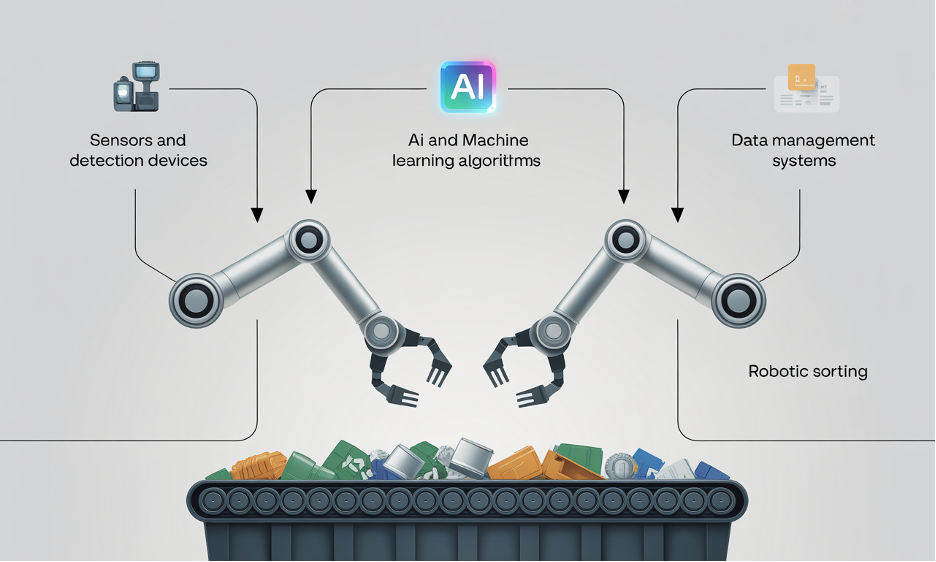
A digital waste sorting system integrates several key components to achieve high operational efficiency:
- Sensors and detection devices: Technologies like near-infrared spectroscopy, X-ray fluorescence, or hyperspectral imaging cameras analyze waste item composition in real-time. Near-infrared spectroscopy detects chemical composition (e.g., polymer type), while X-ray fluorescence identifies elemental composition (e.g., metals, PVC plastics). A combination of these sensors enhances overall sorting accuracy by mitigating the limitations of individual methods.
- AI and machine learning algorithms: These models are trained on large, labelled datasets to classify waste based on visual and compositional data. They continuously learn and adapt to diverse waste streams, improving sorting accuracy over time.
- Robotic sorting arms: Equipped with precision grippers and advanced vision systems, these high-speed systems sort items using various mechanisms (e.g., vacuum suction, magnetic attachments).
- Data management systems: Integrated software monitors waste flow, tracks recycling rates, and optimizes sorting parameters in real-time. These systems provide crucial insights for data-driven decision-making and predictive maintenance.
The implementation offers benefits such as achieving high purity levels (97–99%) for sorted materials, significant reduction in operational costs through automation, and enhanced data management for strategic waste planning.
Legislative Aspects
For the digital waste sorting system to be established and function effectively, an advisable legislative framework could be put in place. This framework should involve policies that mandate higher sorting purity by setting strict purity standards for recovered secondary raw materials. Such requirements create market pull for high-precision sorting solutions. Legislation could also target standardizing waste classification across different jurisdictions. Finally, governments could look to incentivize technology adoption, offering financial mechanisms such as subsidies, tax breaks, or public-private funding initiatives to help companies overcome the significant initial capital investment required for AI-driven machinery and sensor technology.
Technology
The core prerequisite for replication is the sophisticated integration of multiple sensors with deep learning AI algorithms and robotic automation. Effective sorting relies on sensor combination of technologies like near-infrared spectroscopy (for chemical composition, e.g., polymer types), X-ray fluorescence and X-ray transmission (for elemental composition and density), and advanced optical imaging. These sensors must be capable of generating vast amounts of real-time data, which is then processed by high-performance AI/ML models. Furthermore, a robust data management layer is required, utilizing cloud or edge computing to provide the necessary computational power for real-time decision-making, monitoring, and continuous optimization of the sorting parameters.
Finance
Implementation requires a high initial capital investment, encompassing the cost of sensors, high-speed robotic arms, and the underlying data infrastructure. Operational costs include system maintenance, energy consumption, and the continuous effort required to update and refine the AI models with new data. Due to the scale of investment, securing financing typically necessitates a hybrid approach, drawing on both public financing (e.g., government grants or environmentally focused levies) and private financing (e.g., corporate capital or green investment funds). The system’s business potential lies in its ability to generate high economic value by recovering valuable, high-purity secondary raw materials, and by reducing long-term operational costs compared to manual sorting.
Stakeholders
A successful replication effort depends on structured collaboration between stakeholders.
- Waste management companies who operate the facilities are responsible for daily implementation,
- Ttechnology providers supply and maintain the specialized AI models, robotic, and sensor components
- Policymakers/regulatory bodies establish the targets, standards, and funding mechanisms
- Industry stakeholders purchase and utilize the high-purity recovered materials, thereby closing the loop of the material flows.
Establishing strong partnerships facilitates the sharing of best practices, resources, and innovative solutions necessary to overcome technological and financial challenges.
Society
The societal benefit is the achievement of enhanced environmental sustainability by maximizing material recovery, conserving natural resources, and significantly reducing reliance on landfills. While the social dimension is important, particularly in terms of gaining public acceptance and ensuring the system’s longevity, the primary impact is logistical and environmental. A digital waste sorting system enhances safety by reducing human labor in hazardous sorting environments. Although the automation reduces the need for manual sorters, the high-purity output supports downstream manufacturing and recycling industries, creating new forms of skilled labour.
Environment
The environmental implications of digital waste sorting are positive. The solution directly addresses resource depletion by conserving natural resources through increased material recovery. By achieving high purity and high recovery rates, the volume of waste sent to landfills is substantially reduced, mitigating the associated environmental impacts (e.g., land use, potential release of harmful chemicals). Ultimately, the provision of high-quality secondary raw materials allows manufacturers to reduce their dependence on primary materials, leading to a lower overall environmental footprint for production processes.
Safety
Operational safety risks are primarily managed through automation. The removal of human personnel from the direct waste sorting line reduces human exposure to hazardous or sharp waste materials. The remaining risks are associated with the high-speed machinery, including mechanical or electrical failures in the robotic systems. Therefore, strict safety protocols, regular maintenance schedules, and robust monitoring systems are essential to ensure the safe and continuous operation of the machinery.
To Replicate a Digital Waste Sorting System, Execute the Following Steps
1. Conduct a feasibility study: Assess the composition and volume of the local waste stream to define the specific sorting requirements and desired purity levels.
2. Design the system architecture: Determine the necessary combination of sensors considering the types of materials to be sorted (e.g., plastics, metals, paper).
3. Procure hardware: Acquire robotic sorting arms, sensors, and the necessary data infrastructure (including cloud/edge computing resources for cost-efficiency).
4. Develop data management layer: Establish a robust data infrastructure, integrating sensors to monitor, track, and optimize the sorting process in real-time.
5. Select and train the AI model: Choose a suitable deep learning architecture and train it with a diverse, high-quality data representative of the local waste stream. Alternatively, procure an existing model.
6. Configure sorting parameters: Define the operational settings, including target purity levels and sorting speed, ensuring the system can handle the complexity of the local waste.
7. Integrate and test: Integrate all components (sensors, AI, robotics, data systems) and rigorously test the system’s performance, measuring accuracy and throughput against the defined parameters.
8. Ensure continuous improvement: Implement a strategy for regular monitoring and model updates with new data to maintain and enhance accuracy over time, adapting to changes in waste composition.
For more details on the technicalities of the implementation, please see Chapter 2.6 in the Report on digitalization, logistics and spatial optimization.