

How to Assess and Contextualise Environmental Impacts of Waste-Based Bioenergy Systems
Authors: Michael Niggl, Tomáš Slaný and Alexander Koch, GreenDelta
Assessing the sustainability of waste-based bioenergy systems requires robust methodologies. While the life-cycle assessment (LCA) is a scientifically established and well-documented starting point, complex research questions may necessitate a more comprehensive approach. This article offers guidance on adapting the traditional LCA methodology to contextualize its results within the planetary boundaries (PB) framework and incorporate the environmental impacts of establishing novel value chains.
Read more in the Use Case article:
The Most Important Requirements for Success
Data Quality
Context-specific data on realistic biogas scenarios should be researched.
Sound Methodology
Assessing environmental impacts should be based on established assessment approaches.
Evaluation
Test the plausibility and sensitivity of results and make reflect on result limitations.
Contextualising Municipal Environmental Impacts
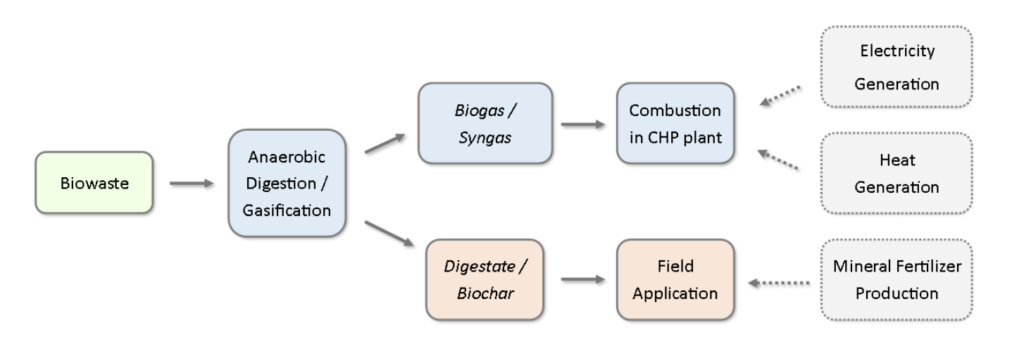
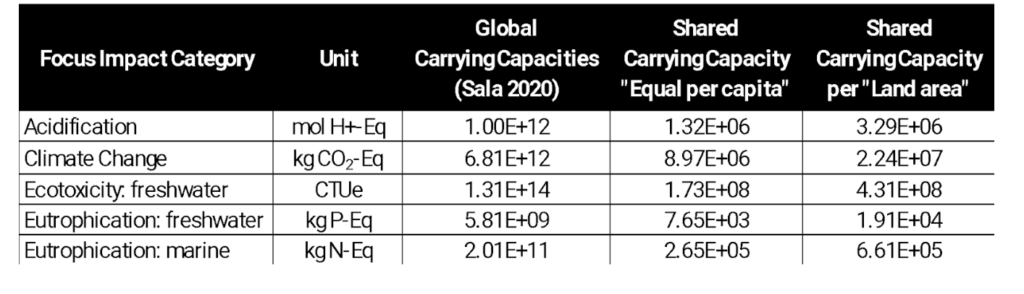
To contextualize the LCA result in the PB framework, they should be compared to the global safe operating spaces defined in the PB framework. As a starting point, some publications like Sala et al. (2020) have compiled a list of global impact limits of all safe operating spaces and made them available to LCA impact categories. However, these global impact limits may be adapted based on the regional context.
The global impact limits should then be scaled (shared) to the study context to determine the regional impact limits (=carrying capacities). For example, to assess the environmental footprints of a municipality, an example of a suitable sharing principle may be equal-per-capita or land-area. To employ the equal-per-capita sharing principle, the global impact limits are divided by the global population and multiplied by the municipality’s inhabitants. Similarly, to employ the land-area principle, the global impact limits are divided by the global land area and multiplied by the municipal land area.
The selection of a sharing principle involves a normative decision of how the global impact limits should be allocated across the world. Consequently, the sharing principle can have a significant effect on the regional impact limits. Therefore, its selection should be critically reflected upon. As part of that, a sensitivity analysis of different sharing principles should be conducted.
Assessing New Value Chains
New value chains and infrastructure can be expected to be in operation over multiple decades. Assessing the environmental impacts of such a new value chain requires modelling of its surrounding economy. For example, it can plausibly be assumed that the global share of regenerative energy increases over the next decades.
A multitude of global socio-economic development scenarios is available to the LCA in the form of the premise tool (Sacchi et al, 2022). This tool allows for the generation of prospective environmental impacts of a product system.
When employing this database, the different impact over time can be compared to different socio-economic development scenarios and different time frames. However, all scenarios introduce an additional source of uncertainty. For best practice, the assessment should critically reflect upon that.
Technology
Calculating the future environmental impacts of a bioenergy value chain requires a dedicated, comprehensive background database. Also, an established impact assessment methodology and impact assessment software should be used. Performing an LCA involves delicate technical decisions that require technical expertise.
Finance
Assessing environmental impacts can be performed with varying levels of technical software. The free and open source software openLCA was used for this study. Simple assessments can be performed based on free, publicly available data. However, a more comprehensive assessment requires financial resources to access the databases used above.
Stakeholders
For a context-specific assessment, it is highly recommended to involve regional stakeholders, specifically during the data collection phase. This can ensure that the acquired data on the bioenergy system properly reflects the regional conditions.
Environment
Assessing the environmental impacts of new waste-based bioenergy systems enables municipal policy-makers and stakeholders to make informed decisions. This is especially relevant, as biowaste-based value chains are not necessarily more sustainable than more conventional treatment practices. Informed decision about biowaste treatment options potentially lead to fewer caused environmental burdens. This improves the living conditions within and outside the municipality, among other advantages.
Organisation
Depending on the scope of the assessment and the technical expertise, a replication may take between multiple weeks or months. This is mainly dependent on the data acquisition phase, specifically the data research and stakeholder involvement.
Checklist
1. Research relevant data.
The assessment should contain relevant life cycle data on realistic bioenergy systems. An ex-ante assessment requires inputs from stakeholders and assumptions about the bioenergy system characteristics. Data quality is essential for the quality of the assessment!
2. Calculate municipal impacts.
Calculate the environmental impacts of the conventional biowaste treatment as well as the waste-derived bioenergy option.
3. Calculate regional impact limits.
Convert the global safe operating spaces to global impact limits. Convert these global impact limits to regional impact limits via a sharing principle. Multiple sharing principles should be tested, as municipal policy-makers may have different normative perspectives.
4. Compare different options and scenarios.
Compare municipal environmental impacts to regional impact limits. Use different scenarios to improve the applicability of the assessment.
5. Evaluate results critically.
Assess the plausibility of the results and conduct sensitivity analyses of critical data points and methodological decisions.
References
Sacchi, R., Terlouw, T., Siala, K., Dirnaichner, A., Bauer, C., Cox, B., Mutel, C., Daioglou, V. and Lu-derer. Gunnar (2022). PRospective EnvironMental Impact asSEment (premise): A streamlined ap-proach to producing databases for prospective life cycle assessment using integrated assess-ment models. 112311. Renewable and Sustainable Energy Reviews (160).
Sala, S., Crenna, E., Secchi, M. and Sanyé-Mengual, E. (2020). Environmental sustainability of Euro-pean production and consumption assessed against planetary boundaries. Journal of environ-mental management 269.