

Case Sweden | System Dynamics Sustainability Assessment of Circular Plastics
Author: Alexander Koch (GreenDelta)
The goal was to assess the introduction of chemical and mechanical recycling technologies in terms of various sustainability indicators. A selection of 3 typical feedstocks (agricultural plastics, industrial plastics, municipal plastics) are recycled. The aim is to introduce new recycled products to the market, which essentially substitute products produced with primary plastics. Assessment results will act as decision-making support for policymakers and businesses.
Read our best practices for replication:
The focus of this case study lies on plastics and especially those plastics, that are viable for mechanical or chemical recycling. Given their abundance in the focus regions of the project, this study especially looks at agricultural, industrial and municipal plastics. In municipalities packaging (bottles, containers, film, wrapping, single-use plastics such as cutlery) and household products (furniture, toys, storage containers, trash bags, disposable hygiene products) are most common. In the agricultural sector plastic films, sheets, nets and twines were found to be most used. The following main polymers are relevant in regard to the above-mentioned applications: HDPE, LDPE, PET, PS, PP, and PVC.
The project focuses its development on the recycling phases of the plastic value chains. The mechanical recycling line is aimed to be improved, where as a technology line applying thermochemical processing of plastic waste via pyrolysis is being developed. The promise of chemical recycling technologies is the conversion of plastic waste to materials that again act as a feedstock for polymers. Chemical recycling thus is a potential strategy for cities and regions to deal with large amounts of plastic waste and simultaneously produce a competitive and innovative material. The chosen case study region was Gothenburg, Sweden, mainly due to the regional focus of the research project.
System Dynamics Sustainability Assessment (SDSA)
A novel sustainability assessment approach is applied combining system dynamics (SD) and LCA, in other words, system dynamics sustainability assessment (SDSA). In the LCA, virgin production is compared against chemical and mechanical recycling for each polymer on the product level. The SDSA occurs on a regional level, meaning the plastic market in Gothenburg is modelled. Polymers studied for the full SDSA included HDPE, LDPE, PP and PET. On the basis of a material flow analysis, these were found to be especially abundant in the studied region.
LCA models were developed for the primary production as well as mechanical and chemical recycling of each studied polymer. The models were developed in the software openLCA, mainly using ecoinvent 3.12 datasets. The prospective LCA model is modelled separately, as it is mainly intended for the SDSA, which considers changes over time. For the prospective LCA, ecoinvent v3.10 was used as a background database. Where data was not available in the ecoinvent database, EcoProfiles for recycled plastics or life cycle inventory data from literature sources were used. As the SD model looks at changes over time, the premise tool was used to generate prospective LCA data.
For the SDSA, the system dynamics model structure defined for the case study includes several interlinked modules. The main value chain activities and material flows are represented in the core value chain module. Further module that shape the external environment of the plastic value chains include the market, environmental impact, resource use, circularity and context scores. The context indicators are modelled separately in the index categories. The context links to different variables throughout the model, essentially influencing system behaviour.
LCA Results at Product Level
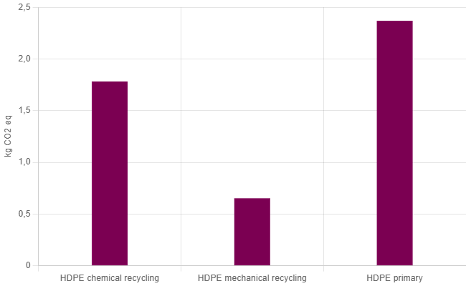
The LCA results were calculated for each production or recycling pathway per 1kg of granulate. As an example, the case of HDPE, mechanical and chemical recycling performed better than primary production in most impact categories. Chemical recycling was found to be clearly worse when compared against mechanical recycling.

System Dynamics Scenarios
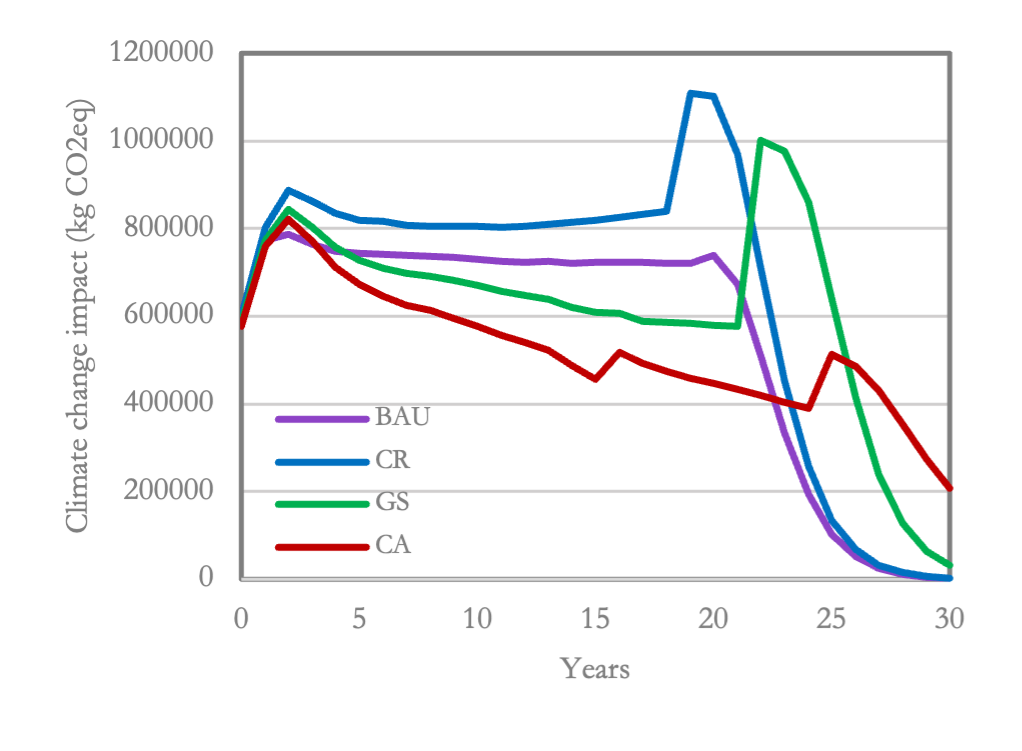
In the system dynamics model, the studied system was simulated for four different scenarios. The first scenario represents business as usual (BAU), where demand trends follow historic trends and there is only a minor increase of recycling rates over time. The second scenario shows the effects of increasing chemical recycling (CR) capacity. This increases chemical recycling capacities of the region, thereby introducing new products to the market. The third scenario goes further and also assumes increasing government support (GS) and funding, both for producers and consumers. Finally, the fourth scenario also considers increasing consumer awareness (CA) towards the benefits of waste prevention and plastic recycling. The four scenarios build up on each other in the following order: BAU, CR, GS, CA.
Environmental Impacts on Regional Level
The environmental impacts calculated with the SDSA extend what was found in the LCA. Here the regional impacts for climate change and resource use are presented.

Resource use (fossil) is modelled as a stock that is depleted by use of resource linked to studied plastic value chains. The BAU scenario shows that resources run out at around year 20. The CR scenario even shows a faster depletion of the resource feedstock. In the GS and CA scenarios, the complete resource depletion can be delayed but not avoided.
The climate change impact for the CR scenario is, contrary to what was expected, higher than the BAU scenario. An impact reduction can only be achieved with additional governmental intervention and heightened consumer awareness. The peak observed towards end of the time line of the climate change impacts are again due to modelling choices. As production and recycling stops once resources run out, the remaining plastics that reach end-of-life only have the option of disposal, which in this case is done through high-impact incineration.
Comparison of Recycling Pathways
In terms of the LCA results, for almost all polymers mechanical and chemical recycled plastics were found to have lower impacts than virgin plastics. When comparing chemical and mechanical recycling, chemical recycling was found to have a higher impact in most cases. Chemical recycling involves several additional processing steps, as the plastic waste is broken down into several original components, which are then used to produce polymers. Especially the production of ethylene was found to contribute significant amount of direct impacts. Furthermore, the pyrolysis of the plastic waste is energy intensive, as it requires high temperatures. In all cases, a significant impact contribution came from the energy supplied during the pyrolysis step.
In the case study, the relatively clean electricity mix in Sweden allows the impact of chemical recycling to remain below that of primary produced plastics. This might not be the case for chemical recycling plants in regions with fossil-based electricity mixes. Further impact reductions were also found to be potentially met by substituting other input materials required along the polymer production chain. As the technology level progresses, chemical recycling can thus become a viable alternative for producing plastics. Nevertheless, a chemical recycling plant should be evaluated in a broader system context, as impact results highly depend on the local energy mix as well as the induced market changes to the linked material flows.
Broad System Observations and Conclusions
Several interesting observations were made when assessing the plastic value chain in the broader system scope. One surprising result of the SDSA was the limited and even negative effect of increasing chemical recycling capacities. When looking at the change in material flows, it becomes visible that the production of virgin plastics slightly decreases with the increase in chemical recycling capacities. Yet, the environmental impact is higher than the BAU scenario for almost all impact categories. For one, this links to the assumption that in the CR scenario sorting does not improve much, meaning a significant amount of the recycling feedstock remains mixed plastic waste. Chemical recycling does process a portion of the mixed plastic waste, but, as found out throughout the project, remains relatively inefficient, meaning most of the input materials are lost to disposal.
Chemical recycling also processes the sorted, mono-material streams, but this leads to less mono-material feedstock being available for mechanical recycling. It is assumed that in order to reach a market-acceptable material quality, mechanical recycling requires virgin additives. The additional amount of plastic additives required partially offsets the positive effect of avoiding virgin plastics on the market, hinting to a rebound effect. Enhancing this further is the assumption that recycled plastics have limited recyclability in subsequent cycles. The lower market availability of primary plastics as a feedstock for recycling therefore increases the demand for additives further. The avoided disposal due to the additional recycling capacities is also offset by the additional disposal of recycled plastics with limited recyclability. In this case, the additional circular economy effort outweighs the promised benefits, showing the importance of considering a wider scope when conducting sustainability assessments.
Additional strategies are needed to observe benefits. From a technical perspective, chemical recycling technologies might benefit from improved efficiency and flexibility in regards to the feedstock. The more effective strategies were observed with the scenarios GS and CA. Government support and funding led to technological development in all areas, including plastic sorting and mechanical recycling. Raising consumer awareness further reduced overall plastic consumption and with that delayed resource depletion and reduced environmental impacts significantly. It becomes evident that a mix of strategies can lead to the best results.