
Case Hämeenkyrö | Environmental Potential of Manure-Derived Biogas
Authors: Michael Niggl, Tomáš Slaný and Alexander Koch, GreenDelta
Most rural municipalities in Finland produce significant amounts of biowaste. In the Hämeenkyrö municipality, the most produced type of biowaste is cattle manure. More than 90% of cattle manure in Finland’s municipalities is applied to fields as raw manure. This practice is generally known to cause various environmental burdens and omits alternative added value uses of cattle manure. To assess the sustainability of a potential biogas plant in Hämeenkyrö, we developed a dedicated context-based sustainability assessment framework.
An alternative usage of cattle manure is anaerobic digestion, also known as biogas production.
Biogas is an already established in multiple northern European countries and is known to improve
the environmental footprint of raw manure application.
However, we found that this general assertion depends on the regional contexts of the biogas
system. Therefore, to assess the sustainability of a potential biogas plant in Hämeenkyrö, we
developed a dedicated context-based sustainability assessment framework. We then performed an
ex-ante sustainability assessment of four common municipal biowaste treatment scenarios. In each
scenario, the biogas feedstock capacity is utilized by a different mixture of biowaste feedstock.
Procedure
In the “No-Biogas Scenario”, the biowaste of Hämeenkyrö is treated by its conventional
technologies. In the alternative scenario, a biogas plant with an annual feedstock capacity of
20,000 tonnes is in operation.
In the second scenario, the feedstock capacity is used by cattle manure. In scenarios three and
four, we investigate two mixtures of cattle manure with co-substrates. These are also abundant
biowaste, namely household food waste or grass clippings.
We limited our assessment to three main sources of environmental impacts:
- Environmental benefits from reducing conventional biowaste treatment,
- Environmental impacts from biogas production, and
- Environmental benefits from avoiding conventional energy generation.
Our assessment used regional-specific data of the biowaste production in Hämeenkyrö, which was
provided by a material flow analysis as part of the TREASoURcE project. Insights into the technology of biogas system processes were transferred from other biogas LCAs.
Following the absolute sustainability assessment approach, we compared the scenario impacts to
environmental thresholds of the municipality, based on the Planetary Boundaries framework.
Following, an excerpt of our assessment results is presented.
Environmental Impacts of Municipal Biowaste Treatment
The following graph reveals the environmental impacts of different biowaste treatment scenario.
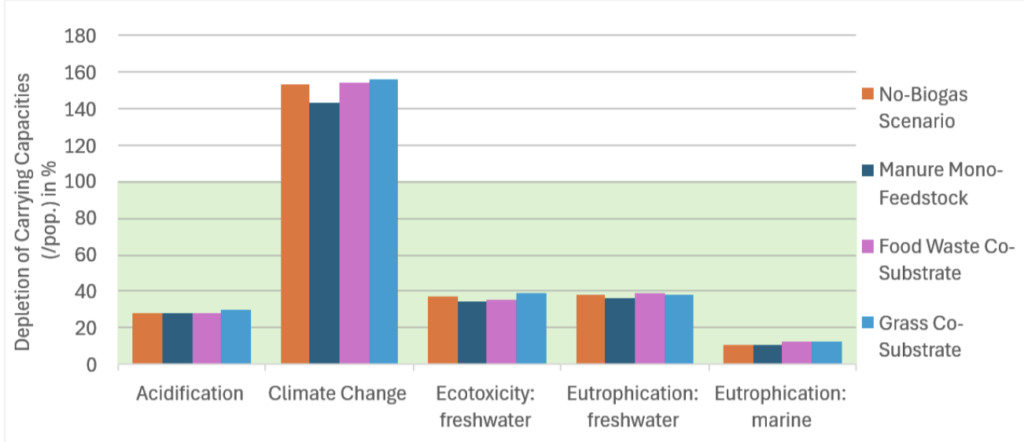
Assessment of municipal environmental impacts of four biowaste treatment scenarios for five
impact categories. Green background = regional environmental threshold. Our assessment found that all biowaste treatment scenarios deplete the municipal thresholds to a similarly significant degree. The climate change impacts appear to be especially relevant, as all four scenarios exceed its municipal environmental threshold.
Against our expectations, we found that anaerobic digestion of cattle manure without co-substrates
like food waste or grass clippings has the most environmental potential. This is especially prevalent
for the climate change impacts.
Since a new biogas plant has an expected operation time of at least 20 years, we also assessed
the expected impacts until the year 2050. We assumed that in this time frame the share of
regenerative energy sources in Finland increases significantly. Therefore, we found that the future
environmental benefits of the biogas scenarios diminish slightly.
In conclusion, our sustainability assessment found that, in the case of the Hämeenkyrö
municipality, using cattle manure as a resource for biogas is promising to improve the municipal
environmental footprint. However, our assessment utilized novel sustainability assessment approaches, which we identified to potentially be immature. Those include shortcomings of the used prospective LCA tool “premise” and low data availability. Therefore, the results presented here should be interpreted with caution.
Further research is required to refine this assessment. We provide more information regarding the study background, our methodology, more detailed results and evaluation in a master’s thesis by Michael Niggl, which will soon be publicly available.