
Case Tampere | Conversion of Plastic Waste into Chemical Building Blocks
Authors: Farah Siddiq, M.Hassam Khan, Sirous-Rezaei Pouya, Elmeri Pienihäkkinen (VTT)
We recognized early on that tackling the growing issue of end-of-life plastics would require more than just conventional solutions. That’s why, through the EU-funded TREASOURCE project, we set out to explore advanced solutions for converting plastic waste into valuable resources. Our goal is to develop a process capable of recycling mixed plastic waste streams collected from municipal, industrial, and agricultural sources with a target of achieving a maximum recycling rate in the future pilot phase via pyrolysis.
Read our best practices for replication:
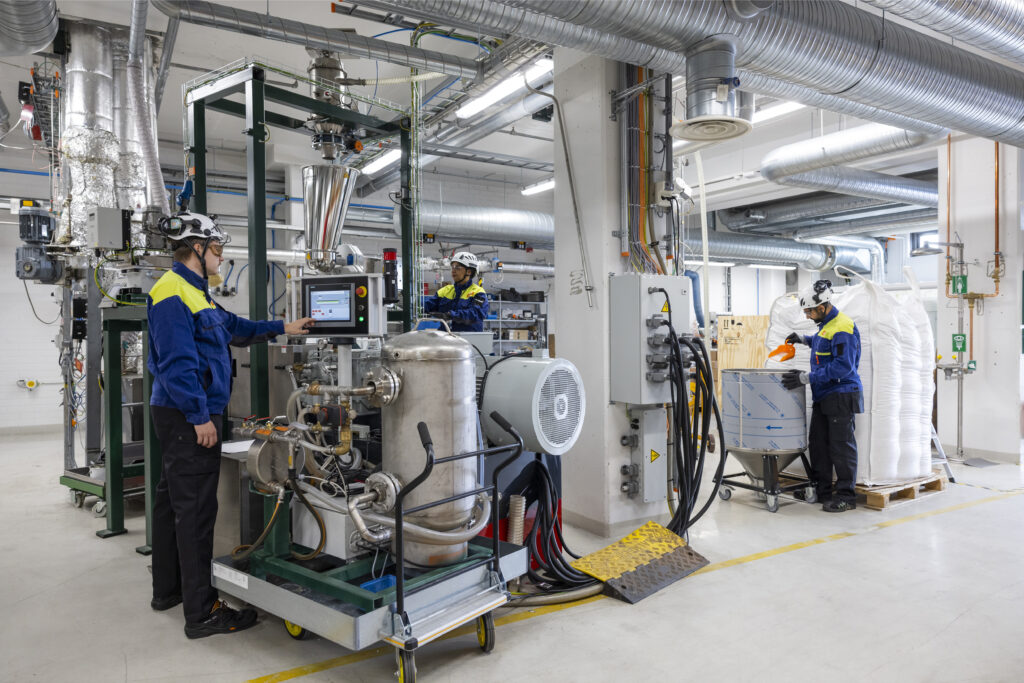
To reach that goal efficiently, we adopted a stepwise development strategy. We first screened catalysts in a 5 g lab-scale batch reactor to maximize aromatic compounds in oil from model plastics and real agricultural plastic waste. We then validated the best catalyst and screened process parameters on a 1 kg/h unit to maximize total oil yield and tune the aromatic oil yield and composition. In upcoming work, we will transfer these learnings into a 2 kg/h Process Development Unit (PDU) and ultimately into a pilot plant, where the objective will be to demonstrate consistent production of high yield of oil with higher selectivity of aromatic compounds under continuous, relevant conditions.
Understanding the Challenge: Real-World Plastic Waste
Our starting point was recognizing the complexity of real-world plastic waste streams. The plastic waste is highly heterogeneous, consisting of various polymer types such as polyethylene (PE), polypropylene (PP), polystyrene (PS), and polyethylene terephthalate (PET). These are the materials found in shampoo bottles (HDPE), grocery bags (LDPE), charcuterie packaging (PP), yogurt containers (PS), and PET beverage bottles. In our study, we focused on agricultural plastic waste that was PE-rich.
In addition to this diversity, the plastics were often contaminated with labels, inks, adhesives, and food residues, and frequently contained additives like stabilizers, flame retardants, or colorants. These challenges make mechanical recycling difficult, as the input material must be clean and sorted to produce high-quality products.
That’s why we turned our focus to chemical recycling, particularly pyrolysis, which can handle more complex and contaminated plastic mixtures.
Why Pyrolysis?
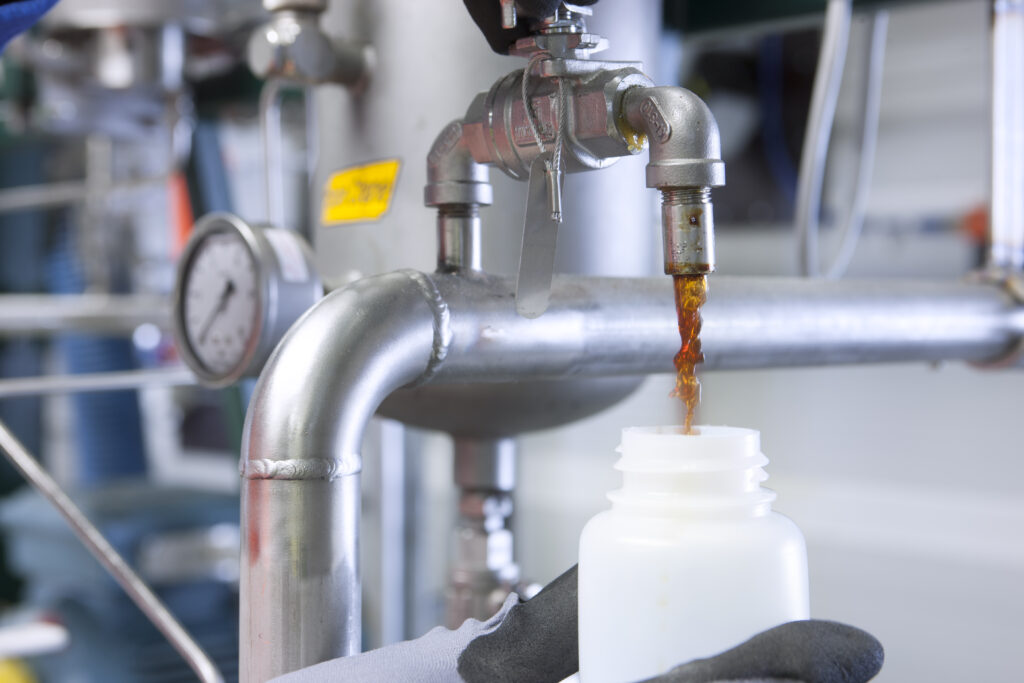
Among chemical recycling techniques, pyrolysis stood out as the most suitable for handling heterogeneous and contaminated plastic waste. In this process, plastics are subjected to high temperatures (typically 500–600 °C) in the absence of oxygen, breaking long polymer chains into smaller molecules often liquid hydrocarbons, gases, and waxes. Crucially, the resulting aromatic oil fraction can be tailored (via temperature, residence time, and catalysts) to increase the share of valuable aromatic compounds, which serve as feedstocks for the chemical industry.
Our Stepwise Approach
1) Lab-Scale Catalyst Screening (5 g Batch Reactor)
We began by conducting small scale experimental trials (maximum 5 g feed) in a custom lab reactor. We tested both model plastic mixtures and real agricultural PE-rich waste. The primary aim at this stage was catalyst screening: identifying catalysts and configurations that enhanced oil yield and aromatic composition.
Key features of this stage included:
- Batch, oxygen-free conditions at controlled temperatures (typically in the 500–600 °C range).
- Comparison of thermal (no catalyst) versus catalytic experiments.
- Testing a double-bed configuration in which plastics were pyrolyzed in a primary zone, and the resulting vapors were passed through a secondary catalytic bed downstream (ex-situ concept). This arrangement allowed us to decouple cracking from aromatization and screen catalyst bed position and sequence.
- Selection criteria included oil yield, oil composition, and tendencies toward coking.
This stage was essential. It enabled rapid iteration across catalysts and configurations and revealed that ex-situ arrangements where vapors contact the downstream catalyst enhanced aromatic oil formation while moderating unwanted polymerization and char.
2) Bench-Scale Parameter Screening (1 kg/h Fluidized Bed Unit)
After identifying the most promising catalyst at 5 g scale, we scaled up to a 1 kg/h fluidized bed unit to screen process parameters with a focus on maximizing total oil yield while refining the aromatic oil fraction. The fluidized bed configuration was chosen for its excellent heat and mass transfer, temperature uniformity, and compatibility with catalytic operation.
Pre-treatment included:
- Visual and mechanical pre-sorting to remove visible non-plastic items,
- Shredding and size reduction for uniform feeding,
Within the 1 kg/h unit, we evaluated:
- Temperature windows tuned to balance cracking severity and aromatics formation,
- Vapor residence time,
- Product condensation trains to capture and preserve the aromatic-rich fractions by storing them in cold conditions.
These continuous trials demonstrated that:
- Conversion efficiency is around 88% to useful liquid, wax and gases under optimized conditions.
- Thermal runs produced broader naphtha-like liquids, while catalytic runs enhanced aromatic content in yield.
- Catalyst deactivation by coking was observed and highlighted the importance of regeneration at larger scale.
3) Planned: Ex-Situ Process Development Unit (2 kg/h)
Building on the success of lab and 1 kg/h work, our next step is to implement the ex-situ concept in a 2 kg/h Process Development Unit (PDU). In this setup, primary pyrolysis occurs in one reactor, and hot vapors are routed through a secondary catalytic bed, designed to further enhance aromatic oil formation.
This stage will focus on:
- Verifying continuous ex-situ operation with real waste inputs,
- Optimizing vapor–catalyst contact,
- Testing catalyst regeneration cycles,
- Demonstrate consistent production of aromatic oil under applied conditions.
4) Planned: Pilot-Scale Demonstration (10–20 kg/h)
Finally, we will scale-up to a pilot system designed to:
- Process 10–20 kg/h of plastic waste,
- Operate continuously for extended campaigns,
- Incorporate catalyst regeneration, heat integration, and product separation,
This pilot will validate the process at industrially relevant throughput, supporting future techno-economic analysis and life-cycle assessment.
What We Learned So Far
From the 5 g and 1 kg/h trials, we established a strong technical basis:
- Conversion & Yields: Over 80% of plastics converted to useful liquids and gases under optimized conditions.
- Product Quality: Thermal runs produced naphtha-like fractions, while catalytic runs enriched the aromatic oil component.
- Catalyst Behavior: Ex-situ catalytic arrangements gave higher aromatic selectivity and better product control but require careful management of coking and regeneration.
- Scalability: Results suggest that lessons from lab and bench scales can be translated into larger systems, though pilot trials will be critical for proving robustness.
Conclusion and Outlook
In this phase of the TREASOURCE project, we successfully ran small-scale chemical recycling trials using lab and bench-scale pyrolysis reactors with various plastic waste types. These trials helped us identify:
- Optimal pyrolysis conditions (temperature, residence time, catalyst),
- Key limitations and mitigation strategies (feedstock impurities, coke buildup),
- The product potential (monomers, fuels, waxes, and chemical precursors).
We now have a scientifically validated baseline to support our upcoming planned PDU (2 kg/h) ex-situ continuous trials and pilot-scale (10–20 kg/h) implementation, which will demonstrate the technology under industrial operating conditions with a larger throughput.
We’re excited to take the next steps toward a circular, climate-friendly solution for plastic waste that’s not only technically feasible, but also economically and environmentally sustainable.With continued research, collaboration, and policy support, we’re confident that chemical recycling can become a key pillar of Europe’s sustainable plastic economy.