

Case Finland | System Dynamics Sustainability Assessment of Biowaste for Biogas and Biofertilizers
Author: Alexander Koch (GreenDelta)
The goal was to assess the introduction of an e-market place and a rural-urban symbiosis tool in terms of its impact on the environment. The tools aim to increase the availability and utilization of bio-based side and waste streams for the production of biogas and biofertilizers. Assessment results will be relevant for the actual and potential users of the tools as well as for the policymakers. Additionally, this case study is aimed at laying the groundwork for future replication for other municipalities.
Read our best practices for replication:
Focus on Regional Bio-Based Side and Waste Streams
On regional level, there is a large variety of different types of bio-based side and waste streams. The ones selected for the assessment were found to have a higher potential for the targeted end-products, namely biogas and biofertilizers, and also were abundant in the selected regions. The bio-based streams assessed in the sustainability assessment include cattle and sheep manure, grass clippings, food waste, municipality sludge, sugar beet tops, potato tops, cereal straw, and pea stems.
System Boundaries and Analyzed Pathways
The system boundaries considered reach from the point where the biomass feedstock is provided to the final products that can be produced using these feedstocks. One pathway is producing biogas and in second step electricity. Digestate is a by-product of the biogas plant that can be used as fertilizers. A second pathway is producing biofertilizers for field applications. All process steps within these pathways were considered. In order allow for a comparison, the current use of these feedstocks were also considered, meaning e.g. the field application of the manure or the incineration of food waste. Markets that are indirectly affected by these changes were also included. This concerns, for one, the avoided current use of feedstocks, e.g. the manure applied to the field and the induced additional need for other fertilizers, and second, the change in electricity and heat mix due to the additional availability of biogas. The chosen case study region was Hämeenkyrö, Finland, mainly due to the regional focus of the research project.
Regional SDSA Boundaries in Hämeenkyrö
The SDSA took on a regional level assessment. The regional boundaries in the case study were defined based on the administrative boundaries of the municipality Hämeenkyrö, Finland. Regional value chain stages therefore include the market for local biomass feedstock coming from side streams as well as the biogas and biofertilizer production. The boundaries were extended to include the consequences of avoided feedstock applications and also the changes on the local electricity and heat market. This way, indirect consequences of decisions can also be observed.
Simulation Scenarios for Biogas and Biofertilization
Five different scenarios were considered. The analysis included a business as usual (BAU) scenario to be compared against four variations that consider the introduction of biogas and biofertilization capacities. The first variation assumes the introduction of 25000t feedstock processing and 5000t fertilizing processing capacities (BG25BF5Base). The second variation considers the same capacities but the additional introduction of CE tools with a low CE factor (BG25BF5Tools1). The third variation considers the same capacities but the additional introduction of CE tools with a medium CE factor (BG25BF5Tools2). And the final scenario assumes the introduction of 35000t feedstock processing and 8000t fertilizing processing capacities as well as the introduction of CE tools with a medium CE factor (BG35BF8Tools2).
System Dynamics Modeling and OpenLCA Integration
LCA models were developed in the software openLCA. The system dynamics model for the case of bio-based side and waste streams was modelled on the basis of available streams in the region and potential valorisation pathways linked to these streams. The main module represented the side and waste streams. The variables are arrayed by the type of feedstock, as different feedstocks might be more suitable or likely to enter certain valorisation pathways. The distribution of the feedstocks is given by the context scores. The higher score, the higher the amount that is distributed to the given valorisation pathways.
The separate module in the model then sums up the predicted amounts for each of the product streams of interest. These variables are then purposed to be linked to parameters in the LCA models. The biogas flow is linked to an electricity and heat mix module. This module is used to predict the changes to the heat and electricity market, induced by the additional biogas made available.
Life Cycle Inventory and Database Sources
The foreground LCI is based on previously compiled LCI data from similar LCA case studies. Econinvent is chosen as the background LCI database for this case study. The background LCA models intended for the SDSA were modelled using literature data collected for the product-level LCA and background data from the SOCA database. This way environmental and social impacts were able to be calculated.
Consequential LCA Results at the Product Level
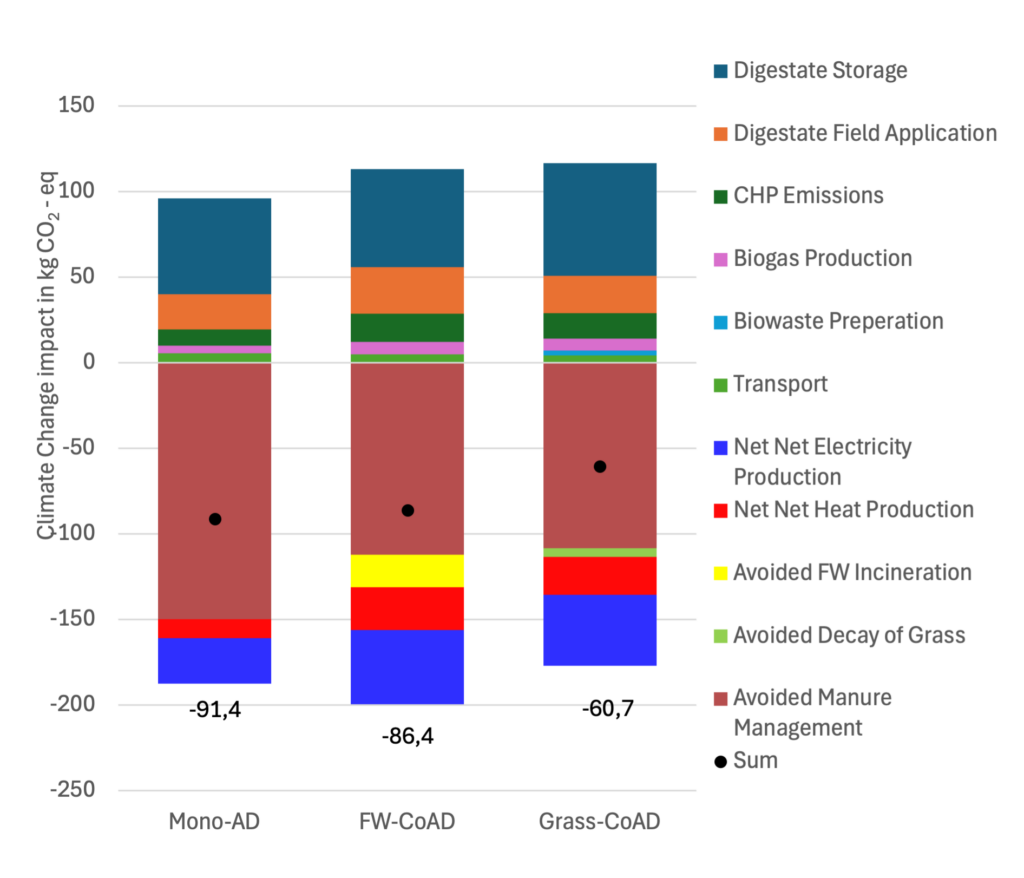
The product-level LCA results take on a consequential analysis, meaning changes on the market and avoided products and waste treatment are also considered. The analysis compares the different valorisation pathways for the treatment of 1 ton of biowaste. All biogas pathways generate environmental credit in the climate change impact category. However, the Mono-AD pathway ranks best among the biogas pathways. The inclusion of co-substrates in the biogas feedstock worsens the environmental footprint of the pathways. The food waste pathway produces a considerable amount of credit from avoiding conventional food waste incineration treatment, while the avoided grass decay plays only a minor role.
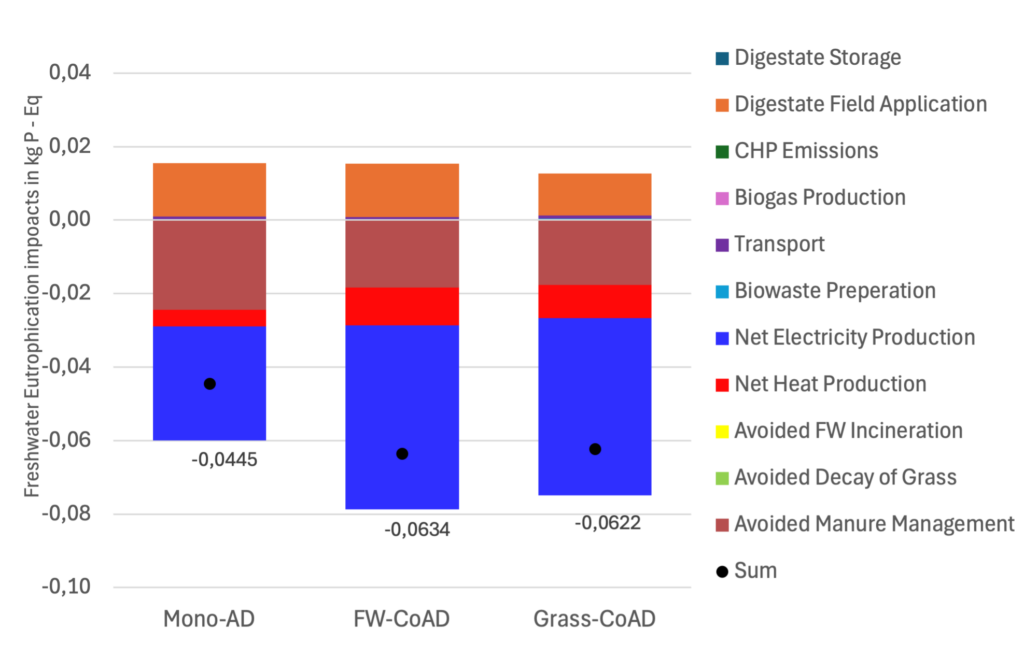
All three biogas pathways result in a reduction in freshwater eutrophication impacts compared to their conventional biowaste treatments. The FW-CoAD pathway is assessed to be the most beneficial biogas pathway, while the Grass-CoAD pathway yields a similar amount of environmental credit. For each biogas pathway, the produced electricity has the single biggest influence on the impacts. Again, the field application and avoided manure management stages play a considerable role and are also relevant.
Regional Impact Assessment via SDSA
The SDSA was performed by linking the system dynamics model to LCA models that allowed for environmental and social impact calculations. The impacts are calculated for the amounts linked to the bio-based side and waste streams in the studied region Hämeenkyrö. It was assumed that it takes around 3 years to build a biogas plant in the region, meaning noticeable impact can be observed from this year onwards. A similar trend can be observed for all scenarios. The base introduction of biogas plant and biofertilizer facility leads to a significant long-term reduction of impact in all categories. With the introduction of tools, such as an e-marketplace for bio-based side and waste streams, the impact can be reduced even further. Even further reduction can be achieved when increasing the biogas biofertilizer production capacities.
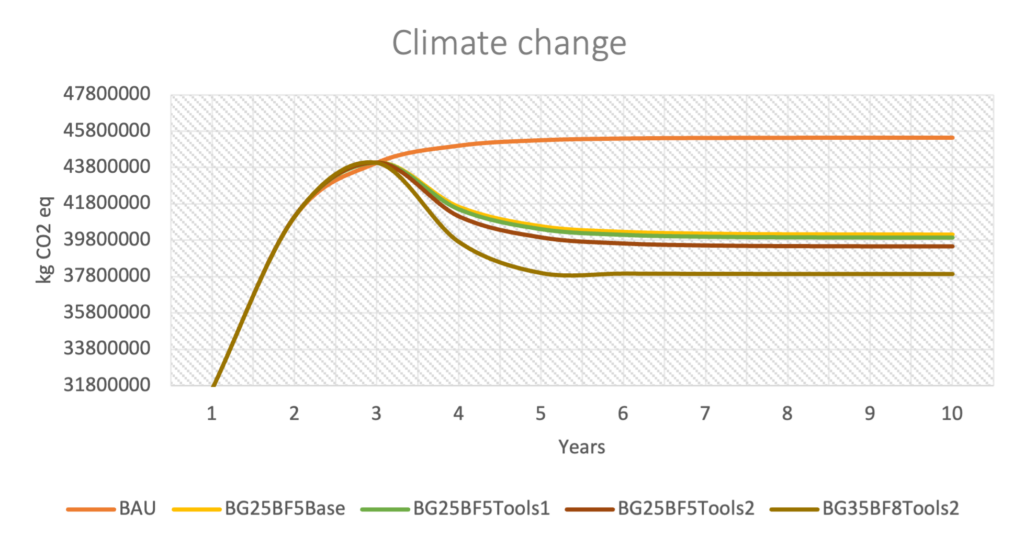
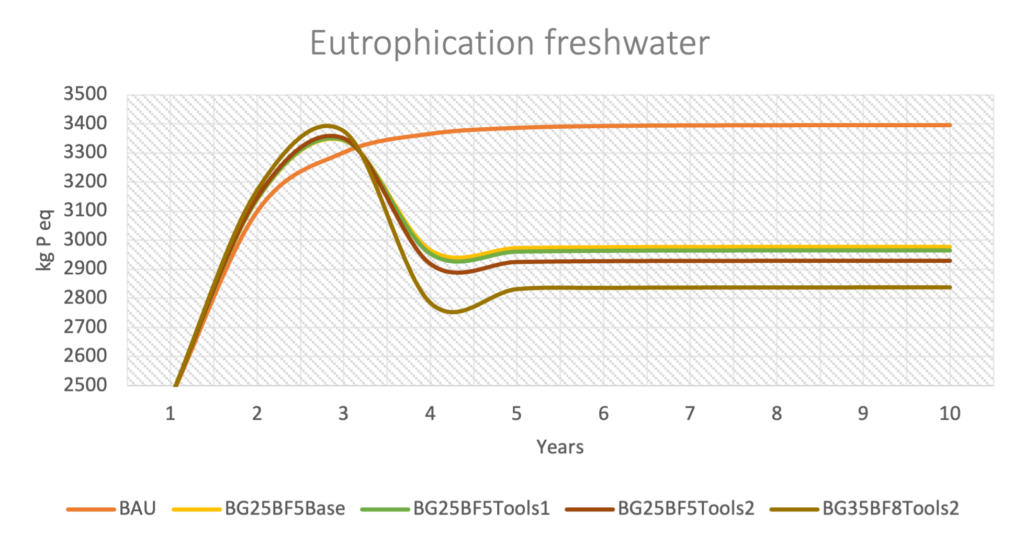
Overall, both consequential assessments in the LCA and SDSA produced insightful results. The LCA showed the environmental benefits of mono-digestion of manure. The SDSA then specifically looked at regionally available bio-based side and waste streams and applied priority scheme that determines the distribution of feedstocks to different valorisation and waste treatment pathways.
Avoided Environmental Impacts on Energy Markets
When taking a closer look at the impacts of the different processes, it becomes clear that the avoided electricity and heat sources are the main reason for the reduction. Regional electricity sources that are avoided include natural gas, nuclear, hydro power and wind power. Especially the reduced need for electricity from natural gas and nuclear power caused significant reduction in some impact categories. The change in heat sources in the district heat mix also were a reason for the reduced impacts, even though reduction potential was found to be lower than that of avoided electricity sources. Regional heat sources avoided due to the increased availability of biogas included woodchips, recovered wood, natural gas, light fuel oil and recovered fuels. The woodchips make up the largest part of the regional consumption mix of heat. The lower reduction potential on the heat market can thus be explained by the competing bio-based energy sources.
Implications for Regional Fertilizer Markets
When looking at the fertilizer market in the region, it was found that the overall fertilizing potential increased with introduced biogas and biofertilizer production capacities. The digestate, which is a by-product of biogas production, was found to have a higher fertilizing potential than the manure that is directly applied to the fields. This also compensated for the lower fertilizing potential of the composted biofertilizer. Compared to the conventional scenario, where e.g. manure and grass is mainly applied to the fields, the biogas plant thus offers a way to increase the fertilizing potential in the region. In the model it was assumed that this additional fertilizing potential replaces the need for conventional fertilizers, which was also found to contribute to the overall reduction of impacts significantly.
Key Conclusions and Future Strategies
In all scenarios, increase biogas and biofertilizer production capacities lead to a decrease in all environmental impact categories. The e-marketplace and the rural-urban symbiosis tool can essentially support in the improved distribution of bio-based side and waste streams to application with high valorisation potential. These nevertheless need to disseminated and developed further in order to realize its full potential.