

How to Transfer Stakeholder Engagement Approaches to Support Circularity
Author: Jelizaveta Krenjova-Cepilova, PhD, TalTech
Stakeholder engagement activities that combine practice, education and social interaction are central instruments for reducing waste, extending product lifetimes, and changing consumption norms. Community-level initiatives can complement regulatory and infrastructural measures towards developing a circular economy. They mobilise citizens, support building repair skills, and can help improve waste sorting behaviour.
In addition to key value chains in focus, TREASoURcE project partners also worked closely with national stakeholders involving business, third sector and professional associations into topical discussion as well as activating ordinary households and citizens. TREASoURcE practices such as toy swap events, fix and repair workshops, waste sorting festivals as well as online waste sorting courses focus on mobilization of citizens, strengthening of local networks and promoting behavioral change.
In TREASoURcE project we aim to understand if and how the solutions we create can be replicated in and transferred to other countries. Stakeholder engagement practices are no exception. In this article, we examine the transferability of different engagement formats and the online waste sorting course developed and replicated during the lifetime of the project. This article is based on discussions with project partners, partners from target areas, desk research as well as two interactive webinars1 focusing on TREASoURcE demonstrations.
Read more about our use case:
The Most Important Requirements for Success
Contextual Fit and Adaptation
The practice must be adapted to local legislation, waste management systems and cultural contexts rather than being copied directly.
Strong Local Partnerships
Successful implementation requires collaboration between municipalities, NGOs, schools, community organisations and waste management actors.
Clear and Accessible Communication
Information must be available in local languages and communicated through engaging formats that motivate citizens to participate and change behaviour.
Definitions, Objectives & Key Stakeholders
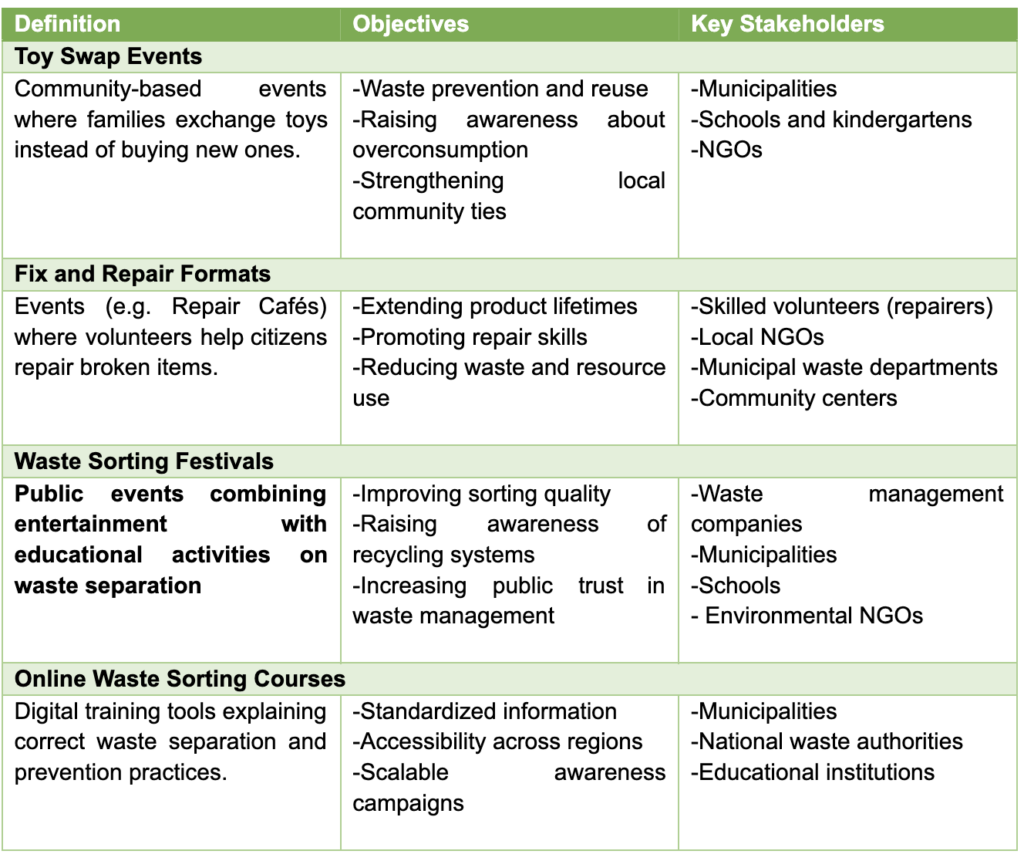
Toys swap events, fix and repair workshops & cafes, waste sorting festivals and online waste sorting courses act on different behavioral levels (capability, opportunity, motivation) and are in essence complementary: digital courses deliver knowledge, festivals build norms and trust, swaps create reuse markets, and repair workshops build capability.
The following table demonstrates their objectives and key stakeholders that are essential for successfully implementing the practice.
Criteria of Transferability
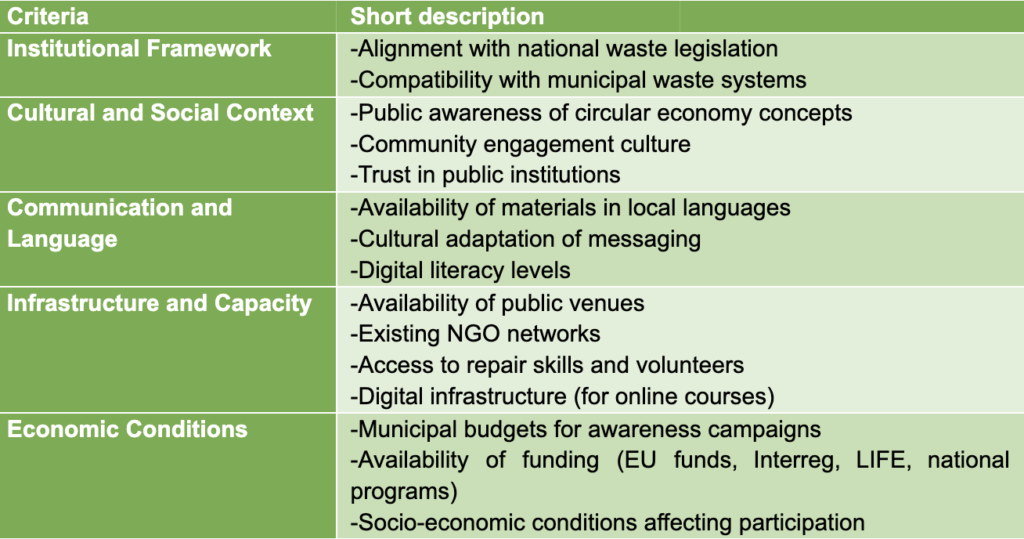
Given the heterogeneity in institutional settings, socio-economic conditions and civic culture across the target territories, successful transfer requires explicit attention to contextual fit. Nevertheless, based on discussions, webinars and workshops in the target areas we can develop universal criteria that is important for transferability of an engagement practice.
1. Institutional Framework
The institutional framework is an important factor in determining whether stakeholder engagement practices can be successfully transferred to different regions. Initiatives such as repair workshops or waste-sorting campaigns need to align with national waste legislation and policy objectives to ensure legal consistency and policy support. Conformance with municipal and national waste rules and alignment with EU regulations that shape national systems is important2.
2. Cultural and Social Context
The cultural and social context significantly influences the successful transfer of stakeholder engagement practices. Public awareness of circular economy concepts determines how easily activities such as repair workshops, toy swaps or waste-sorting campaigns are understood and accepted. The strength of community engagement and volunteering culture plays an important role. In addition, trust in public institutions and waste management systems is essential to ensure credibility, sustained participation and long-term behavioural change.
3. Communication and Language
Communication and language are crucial factors for successful engagement. Information materials and educational content should be available in local languages to ensure accessibility and broad participation. Messages and communication strategies also need to be culturally adapted so that they resonate with local values, habits and social norms. In addition, varying levels of digital literacy should be considered, particularly when implementing online courses or digital awareness tools.
4. Infrastructure and Capacity
The availability of suitable public venues, such as community centres, schools or municipal facilities, enables the organisation of engagement events. Existing NGO networks and community organisations can provide essential support in terms of coordination, outreach and volunteer mobilisation. In addition, access to repair skills, volunteers is necessary to support hands-on repair activities.
5. Economic Conditions
Adequate municipal budgets are often necessary to support awareness campaigns, event organisation and communication activities. In addition, the availability of external funding sources, such as EU programmes, Interreg, LIFE or national environmental funds, can significantly facilitate the implementation and scaling of these initiatives. Socio-economic conditions may also influence participation, as factors such as income levels can affect citizens’ ability and willingness to engage in such activities.
Overall, we should be mindful that successful transfer requires:
- Context-sensitive adaptation
- Institutional alignment
- Financial and organizational capacity
- Strong local partnerships
When carefully adapted, these practices can significantly strengthen circular economy transitions and foster long-term behavioral change across the region.
————————————————————————————————————————————-
- TREASoURcE webinars are accessible: WEBINAR 1 RECORDING: Exploring Fix and Repair Formats: Cases from Across Europe (conducted 25.11.2025); WEBINAR 2 RECORDING: Circular Economy Education Cases in Nordics and Beyond: Theory and Practice (conducted 3.12.2025). ↩︎
- European Commission (2024). Waste Framework Directive. Available at: https://environment.ec.europa.eu/topics/waste-and-recycling/waste-framework-directive_en (Accessed: 4 March 2026).
European Commission (2024). Right to Repair Directive. Available at:
https://environment.ec.europa.eu/topics/circular-economy/right-repair_en (Accessed: 4 March 2026). ↩︎