

Case Tallinn | Reducing Food Waste Through Kindergartens’ Food Sharing Cabinets
Author: Katarina Papp, Circular Economy Expert, Tallinn Strategic Management Office | Tallinn
In Tallinn, we prepare and serve a lot of food every single day in our kindergartens. That’s a wonderful thing — it means children get warm meals and healthy routines. But it also means that even small forecasting errors (a few children absent, a menu item less popular than expected, a last-minute schedule change) can leave us with perfectly edible food at the end of the day. With the EU setting increasingly concrete food waste reduction targets, we wanted to move from “good intentions” to a practical system our institutions can run every day. This is how we did it.
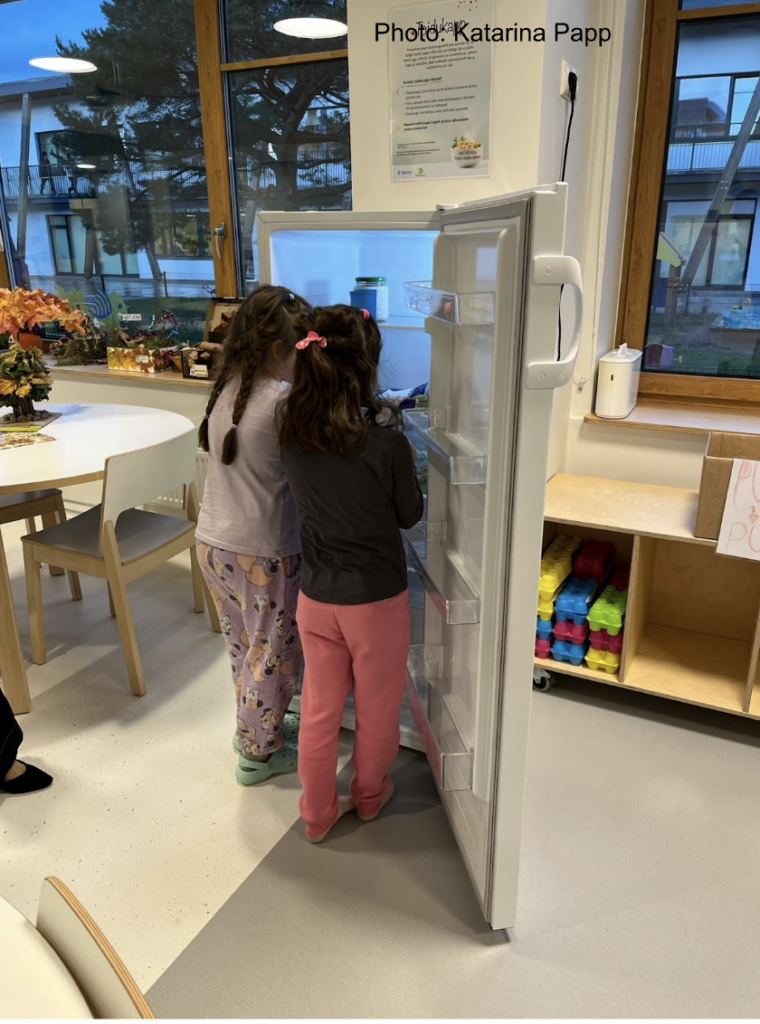
We all know the bigger picture: Estonia wastes an enormous amount of edible food each year, and when food is thrown away, we also throw away the resources behind it — energy, water, transport, packaging, storage, and time. For that end, we piloted a very simple, very human solution: the food sharing cabinet in city kindergartens — a dedicated fridge where same-day leftover food can be placed so that it can be taken home by members of the kindergarten community (families, teachers and other employees) instead of being wasted.
We love this pilot because it proves something important: circular economy solutions don’t always need complex infrastructure. You only need a fridge, clear rules, trust, and a community that wants to do the right thing.
Read our best practices for replication:
We were testing a full, real-life operating model:
- Can kindergartens run a food sharing system without extra bureaucracy?
- Will families and staff actually use it — and feel good about it?
- Can we make food safety requirements clear enough that teams feel confident?
- What kind of support is needed to scale it across the city? What is needed to scale it also to schools?
We also knew one key thing from early conversations: many kindergartens liked the idea, but hesitated for two reasons: Food safety uncertainty and what parents think. Kindergartens were afraid of “doing it wrong” and unintentionally violating food safety rules. Also, they weren’t sure how to approach with the idea to the families. With this in mind, we did the following:
1. We Visited Several Kindergartens
The kideergartens were located around Estonia that have already started with food sharing cabinets from their own initiative. With these visits we saw how the system works and what are the learning points.
2. We Organized an Information Day for Kindergartens Interested in Joining the Initiative
In Alasniidu kindergarten that had been using food sharing cabinet for few years already, 25 kindergartens came together to learn, ask questions, and saw how the system can work in practice. We deliberately designed the event to be practical — not theoretical. We shared experiences from kindergartens where a food cabinet system was already functioning. We invited partners who could speak honestly about what works, what fails, and what needs daily attention. Most importantly, we included a food safety expert (from the national level) to explain how to use a food cabinet in a way that keeps all food safety requirements covered.
3. We Removed the Biggest Practical Barrier: Equipment
After the information day, each kindergarten assessed their readiness:
- Could they find a suitable fridge themselves?
- Could they get one through parents or existing resources?
- Or did they need support?
To make sure the pilot would not stall due to budget or logistics, the City of Tallinn supported the roll-out by purchasing refrigerators for 11 kindergartens.
4. We Standardised the Rules (so Every Site Doesn’t Reinvent Them)
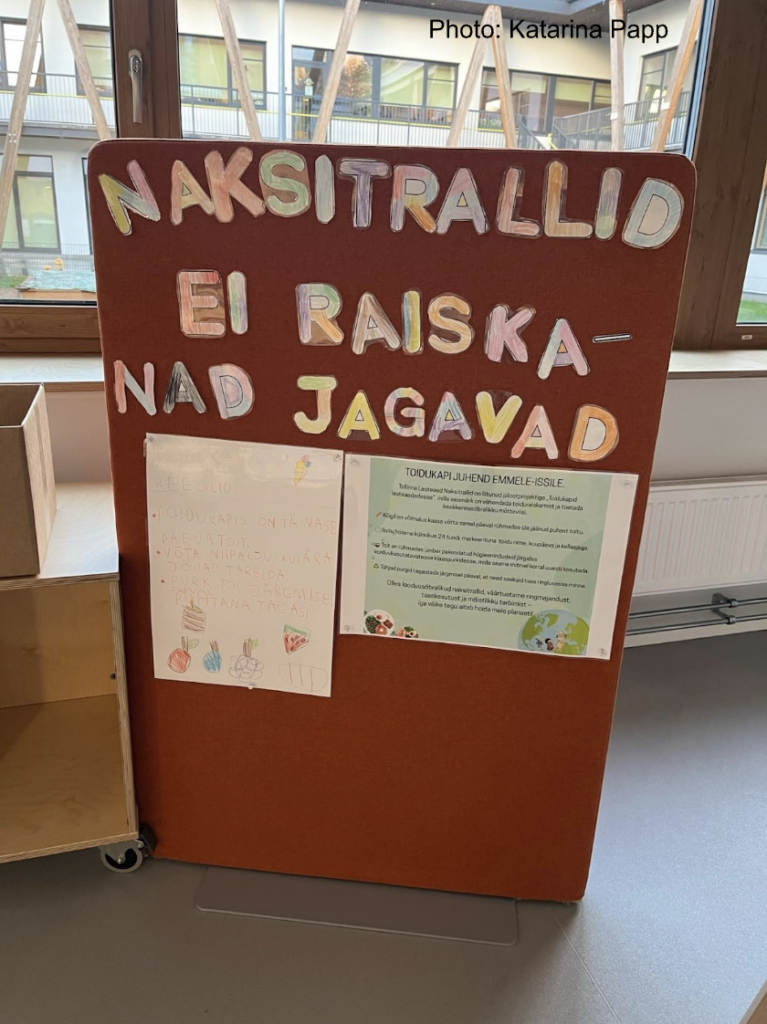
To keep implementation consistent and easy, we provided a shared communication base: a common poster explaining the principles of the food cabinet — what goes in, how it is handled, and how the community uses it. The logic was simple: if we want a network, we need shared basics. Standard guidance reduces confusion, protects food safety, and makes it easier for staff to explain the system to families.
5. We Kept the Operational Model Simple and Realistic
The cabinet is not a complicated donation system. It’s a community sharing point inside the kindergarten. Here is the everyday workflow we piloted:
- Only same-day leftover food is placed into the food cabinet.
- All members of the kindergarten community may take food: parents, teachers, and other staff.
- Each kindergarten is responsible for keeping the cabinet in order. In some sites, responsibility is rotated by groups; in others, the kitchen assistant or another staff member manages it.
- Mostly glass jars are used for sharing the food. Clean jars will be collected from the families. Families return them to the kindergarten. If the personnel of the kindergarten suspects that the jar is not clean, she will clean it over to guarantee the food safety.
This approach worked because it fits kindergarten reality: clear responsibility, minimal extra steps, and no dependency on external transport or third-party collection.
Early Outcomes
Even in the early phase, the feedback from the 11 kindergartens has been strongly positive. Families and staff have welcomed the system. The food cabinet isn’t only for families in need. The main aim is to prevent perfectly good food — and the resources behind it — from going to waste, no matter a family’s income level. Through the cabinet, kindergartens are saving litres of edible food every day — food that used to be thrown away simply because “the day ended.”
One of the most heartwarming parts of the pilot was seeing how naturally children embraced the idea. They helped create the rules — writing and decorating them — and in many kindergartens they also help with daily routines, like bringing jars to the fridge. And maybe most importantly, children set the tone: they take away the ‘is this embarrassing?’ feeling some adults might have and turn it into something completely ordinary. For them, it’s simple — it’s normal to save food.
The initiative has also sparked wider interest: after the public communication, additional kindergartens contacted us, and a national organisation (the Estonian Association of Business and Professional Women) expressed interest in helping expand the idea further.
Learnings
Food safety clarity is the real accelerator. Once food safety expectations were explained in a practical manner (with real examples, not just references to rules), kindergartens were ready to move. The system succeeds when it respects staff workload. The pilot worked because we did not add a heavy reporting burden or complex procedures. We focused on a routine that staff can maintain on a busy day.
Standardisation helps scaling. Shared principles, shared messaging, and a clear operational model reduce friction when new sites join. A city-wide network cannot rely on 60 different interpretations of the same idea.
Next Steps: from Pilot to Network (Spring 2026)
In spring 2026, we will bring together two groups:
- kindergartens that already have food cabinets, and
- kindergartens that want to start.
We will use this meeting to compare practices, share lessons learned, and refine the model so that it becomes even easier to replicate. We will also continue supporting kindergartens that need equipment by purchasing refrigerators where necessary.
Our long-term goal is ambitious but realistic: expand the food cabinet network to all Tallinn kindergartens and, over time, also to schools.