
How to Reduce Food Waste through Kindergartens’ Food Sharing Cabinets
Author: Katarina Papp, Circular Economy Expert, Tallinn Strategic Management Office | Tallinn
Daily food preparation in kindergartens inevitably creates a structural risk of food waste. Even minor forecasting deviations, such as a few absent children, a less popular menu item, or a last-minute schedule change, can leave perfectly edible food unused at the end of the day. Without a dedicated system, this food is usually discarded. To combat this, and in support of EU food waste reduction targets, the city of Tallinn introduced a practical, everyday circular economy solution.
The social dimension is essential for the successful implementation of this practice. A food sharing cupboard sends a strong and visible message that wasting edible food is not acceptable. At the same time, it reframes food saving as something positive and sensible rather than something associated with need or shame. The cupboard communicates that saving food is a smart, responsible choice made by a community that values its resources.
The practice also strengthens a sense of shared responsibility. It creates a feeling that families, staff, and institutions are working together toward a common goal. This community aspect increases acceptance and normalises participation across different income levels, lifestyles, and backgrounds.
Importantly, the social impact extends to children. By involving children in everyday routines around the food sharing cupboard, the practice helps establish food saving as a normal and natural behaviour from an early age. Children grow up seeing that edible food is valued and that preventing waste is part of everyday life. This long-term cultural shift is one of the most significant benefits of the practice and supports lasting changes in attitudes toward food and consumption.
Read more about our use case:
The Most Important Requirements for Success
Do the Groundwork and Validate the Model before Launch
Coordinate the plan with the food safety authority, visit kindergartens where the system already works, and translate lessons learned into a practical, approved operating model.
Keep the Daily Workflow Minimal and Realistic for Staff
Assign clear responsibility – one person or a rotating system –, avoid extra bureaucracy, and make the routine doable even on busy days.
Standardise Communication and Rules across all Sites
Use one shared poster/guideline so families and staff receive the same message everywhere, reducing confusion and enabling scaling.
The Replicable Practices
In Tallinn’s case, the preparation phase was relatively time-efficient but required focused coordination. Preparatory activities included visiting five kindergartens where food sharing cupboards were already in operation. These visits were used to understand practical workflows, identify risks, and collect real-life lessons that could be applied to a wider pilot.
Following this, an information day for kindergartens interested in joining the initiative was organised. The event was hosted by a kindergarten that already had a functioning food sharing cupboard, which allowed participants to see the system in practice. Representatives from the national food safety authority (PTA) were invited to address food safety requirements, and experienced kindergartens shared their practical experiences. The preparation and organisation of this phase took several weeks, including coordination with speakers and participating institutions.
Stakeholder engagement was integrated into the preparation process. Discussions with kindergartens, staff, parents, and PTA took place mainly during the visits and the information day, as well as in follow-up communication. After the information day, data was collected from kindergartens to determine how many required support with equipment.
Based on this input, a procurement process was carried out, including the purchase, transportation, and installation of refrigerators. Once the cupboards were in place, time was allocated to collecting initial statistics and feedback from participating kindergartens in order to assess functionality and identify improvement needs. Overall, the topic was managed by a small, focused team of two people.
Place the Challenge in a Wider Context
Estonia wastes a large amount of edible food every year. When food is thrown away, all the resources behind it are wasted as well: energy, water, transport, packaging, storage space, and working time. In parallel, the European Union is introducing increasingly concrete food waste reduction targets. Respond to this reality by moving from general sustainability intentions to a practical, everyday solution that institutions can operate independently.
Pilot a Simple and Realistic Model
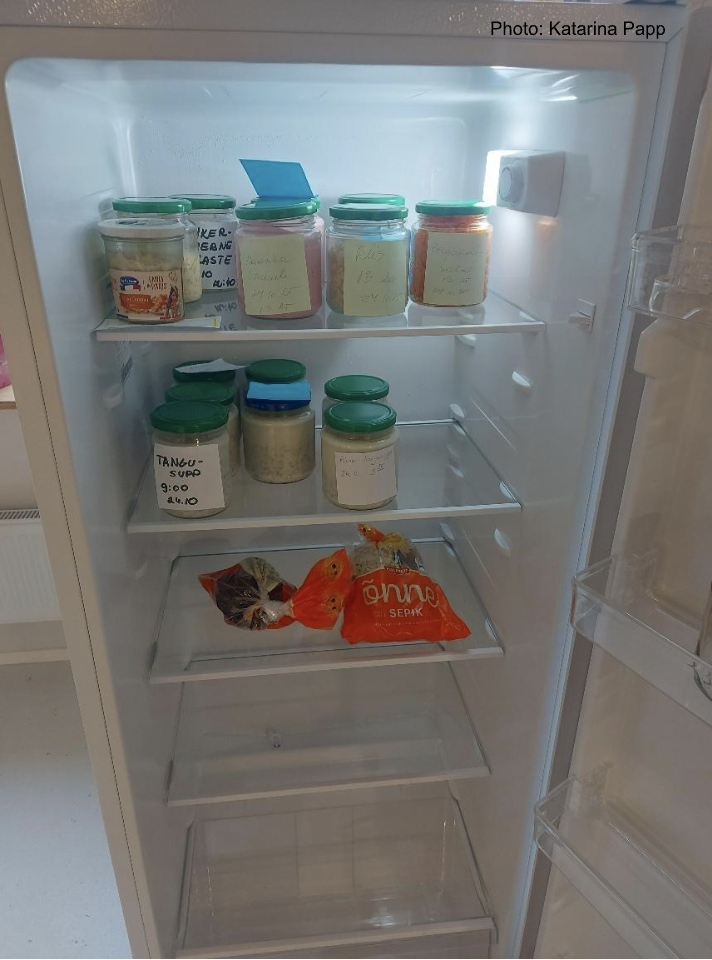
Introduce a food sharing cabinet in kindergartens. Use a dedicated refrigerator where same-day leftover food can be placed and taken home by members of the kindergarten community — families, teachers, and other staff. Treat the cabinet as a community-based sharing point, not as a formal donation system or charity initiative. Keep the concept human, transparent, and easy to understand.
Test the System under Real-life Operating Conditions
Ask clear and practical questions from the start. Ensure that kindergartens can run the system without additional bureaucracy. Verify that families and staff are willing to use the cabinet and feel comfortable doing so. Clarify food safety requirements so teams feel confident rather than hesitant. Identify what type of support is needed to scale the model city-wide and later expand it to schools.
Start with thorough Groundwork
Coordinate the concept and the operational plan with the food safety authority. Validate the approach before implementation. Visit kindergartens that have already introduced food sharing cabinets independently. Observe how the system functions in everyday routines and document concrete learning points. Use this knowledge to design a model that is compliant, practical, and credible.
Engage Staff and Parents from the Beginning
Address the two most common concerns directly: food safety uncertainty and fear of parental reaction. Organise a practical information day for interested kindergartens. Choose a host site with existing experience. Design the event to be hands-on rather than theoretical. Share real experiences from kindergartens where the system already works. Invite partners who can speak honestly about what succeeds, what fails, and what requires daily attention. Include a national-level food safety expert to explain requirements in plain language and confirm that food safety can be ensured.
Remove Practical Barriers Early
Assess readiness in each kindergarten after the information session. Determine whether a suitable refrigerator already exists, can be obtained through parents or internal resources, or requires external support. If needed, provide central support to ensure that budget or logistics do not prevent participation. Treat equipment availability as a prerequisite for success.
Standardise Rules and Communication
Provide a shared poster or guideline that explains the basic principles of the food cabinet: what food can be placed inside, how it must be handled, and how the community may use it. Apply the same core rules across all sites. Standardisation reduces confusion, protects food safety, and makes the system easier to explain to families and staff. Enable scaling by ensuring that the network does not rely on dozens of different interpretations.
Keep the Daily Workflow Simple and Realistic
Place only same-day leftover food into the cabinet. Allow all members of the kindergarten community to take food. Assign clear responsibility for keeping the cabinet in order, either through rotating responsibility or a designated staff member. Use mainly glass jars. Collect clean jars from families and require their return. Clean any jar again if cleanliness is uncertain to ensure food safety.
Observe Outcomes and Normalise the Practice
Note that families and staff are likely to respond positively. Emphasise that the cabinet is not only for families in need; its main purpose is to prevent edible food from being wasted regardless of income level. Involve children in creating rules and daily routines. Let children help normalise food saving behavior and remove stigma.
Plan to Scale Deliberately
Bring together experienced and new participants to compare practices and refine the model. Continue targeted equipment support where necessary. Expand gradually to all kindergartens and, over time, to schools. Build a network based on trust, clarity, and shared responsibility.
Other Things to Consider
LEGISTLATIVE ASPECTS
Verify with the national food safety authority (PTA) under which conditions food may be placed in a food sharing cabinet. In some countries, only unserved food may be donated, while in others it is permitted to donate also previously served food, provided that it has been handled and stored under specific conditions.
Clarify the maximum period during which food may be stored in the food sharing cabinet before it must be removed.
TECHNOLOGY
The technological requirements for this practice are minimal. The only essential technology needed is a dedicated refrigerator.
FINANCE
The only thing you need is a working fridge. Before buying one, ask from the parents – maybe somebody has at home or work a fridge that they don’t use anymore.
STAKEHOLDERS
Kindergarten management and staff
Engage directors, kitchen staff, teachers, and support staff early. Their daily involvement is essential for operating the cupboard, ensuring food safety, and integrating the practice into existing routines.
Families
Inform and involve parents from the outset to build trust and acceptance. Clear communication helps address concerns related to food safety and avoids misunderstandings about the purpose of the practice.
Food safety authority (PTA)
Coordinate the concept and operating rules with the national food safety authority. Their involvement provides legal clarity, builds confidence among institutions, and ensures compliance with food safety requirements.
Procurement and logistics partners
Engage procurement units and logistics providers for the purchase, delivery, and installation of refrigerators to ensure smooth and timely implementation.
Kindergartens with prior experience
Involve institutions that already operate food sharing cupboards. Their practical knowledge and peer-to-peer learning are valuable for new participants.
Children
Include children in age-appropriate ways. Their participation helps normalise food saving behaviour and supports long-term cultural change.
External partners (optional)
Consider involving NGOs or professional organisations interested in food waste reduction or circular economy to support communication, scaling, or knowledge sharing.
ENVIRONMENT
When food is wasted, all the resources used to produce it are wasted as well: energy, water, transport, packaging, storage capacity, and working time.
SAFETY
Operational risk is that food may remain in the cupboard longer than intended. Although this has not been confirmed by our pilot experience, it remains a theoretical risk if clear routines and responsibility are not in place.
Another risk is related to staff engagement. If staff are not involved from the beginning or if the system is perceived as extra work, there is a risk that daily oversight may be neglected. Active involvement of staff from the start is therefore essential to ensure that the cupboard is maintained consistently and safely.