
How to Create Local Bioeconomy Model
Author: Jaana Koivisto, EcoFellows Ltd
The TREASoURcE project has promoted local bioeconomy models based on biogas and recycled fertiliser production. The aim of the project has been to increase the production of renewable biogas and recycled fertilisers, while local models increase the self-sufficiency and security of supply of regions and support the development of the local economy.
Biogas can be produced from almost any organic waste: household biowaste, sewage sludge, manure, industrial side streams (e.g., food industry), agricultural side streams, etc. Biogas is formed when microbes break down organic matter without oxygen. It is a renewable energy source and biofuel. The biogas process produces also nutrient-rich digestate, which can be used as fertilizer. The TREASoURcE project has focused on manure and other agricultural side streams, as they provide valuable digestate to produce organic fertilisers.
The local perspective is important because transporting most types of biomass long distances to biogas plants for processing is neither economically nor ecologically sustainable. According to some calculations, it is not profitable to transport slurry more than 10–20 kilometres, or dry manure more than 20–30 kilometres. These are, of course, only rough estimates and situations vary, but in any case, locality is an important factor in biogas production.
The TREASoURcE project has developed cooperative models in collaboration with some municipalities in the Pirkanmaa region, near Tampere, Finland. Municipalities are responsible for regional planning in Finland and therefore play an important role here. The development work has resulted in a functional cooperation model: the Local Bioeconomy Model. The Rural Urban Symbiosis Tool also developed in the TREASoURcE project is an excellent tool for developing Local Bioeconomy Model.
Read more about our use case:
Replicable Practices
Building on experiences recognised during the project, the following replicable practices highlight the key elements of the bioeconomy model. They translate the lessons learned in the TREASoURcE project into practical steps that other regions can adapt to their own contexts. While local conditions always vary, the core principles – provide a transferable foundation for strengthening regional self-sufficiency and advancing the circular bioeconomy.
1. Bring Key Players Together
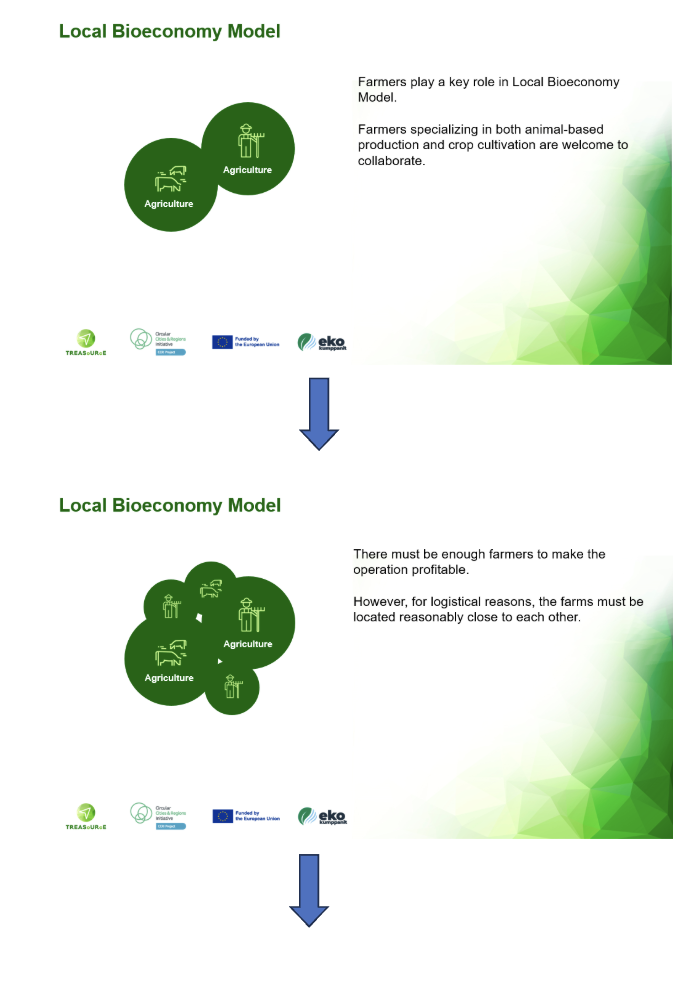
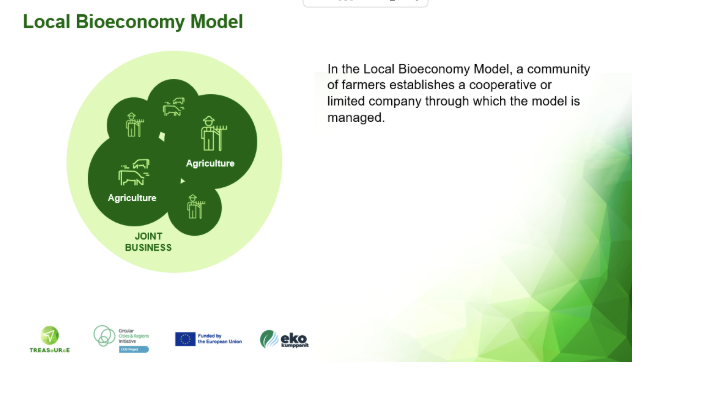
A local bioeconomy model is created around key players. Key players are those who establish a joint venture for the purpose of the activity. Farmers have been key players in the TREASoURcEn model. However, it is possible to create a local bioeconomy model involving other players, such as local wastewater treatment plants. The most important thing is to identify the core players and find a common will for cooperation.
2. Engage Key Players
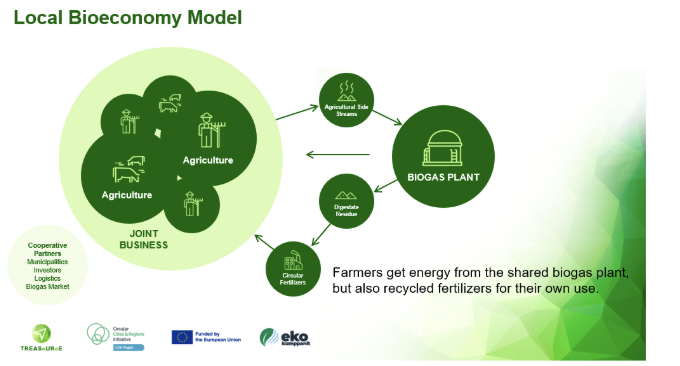
To get key players committed to cooperation, they need to be aware of the concrete benefits to be gained from it. For example, the benefits of a shared biogas plant for farmers include ecological and affordable energy and self-sufficiency in energy. High-quality organic fertilizers from biogas digestate, which also might increase crop yields. Financial savings in both energy and fertilizers and potential reduction in waste management costs.
3. Take Development Further
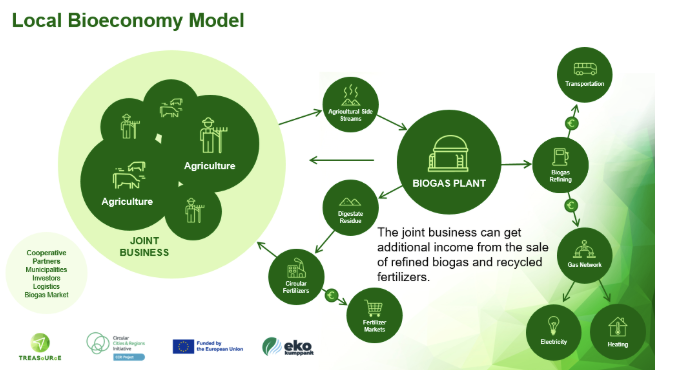
The farmers’ joint biogas plant provides biogas and recycled fertilizers to participating farmers, but it is not yet a local bioeconomy model on its own; other actors are also needed. When the biogas company invests in a refining unit, biogas can also be sold externally.
4. Involve Cooperation Partners
The joint venture can generate additional income from the sale of refined biogas and recycled fertilizers. This also gives other local operators access to renewable energy and locally produced, organic fertilizers. Therefore, in addition to the key operators, it is advisable to involve local industry and other companies in the development of the model, as well as municipalities.
5. Aim High
At its best, a Local Bioeconomy Model can create a local agroecological symbiosis in which both energy and nutrients circulate in a closed loop.