

How to Implement a Digital Product Passport – Transition to Circular Economy
Author: Tomáš Slaný, Green Delta
The Digital Product Passport (DPP) is a crucial digital certificate technology for the transition to a Circular Economy. It provides a product’s value chain stakeholders with information on its materials, components, and sustainability performance across its entire life cycle.
By enabling transparency and traceability, the DPP allows actors (manufacturers, consumers, recyclers, etc.) to optimize product design, track material flows, and make informed decisions about product management and sustainability. Successful implementation requires a strategic, multi-actor approach, focusing on data management, standardization, and technology integration.
The Most Important Requirements for Success
Multi-Actor Collaboration and Stakeholder Engagement
All actors must collaboratively define data needs, contribute accurate information, and be willing to invest in the necessary technology and training. This collective engagement ensures the system is effective and traceable, preventing inefficiencies across the supply chain.
Standardised and Verifiable Data
Data must adhere to standardized formats and protocols to ensure interoperability across different systems and stakeholders.
Unique Product Identifier for Traceability
A successful DPP must be able to link the digital information to the physical product and its components throughout its entire life cycle.
Why Implement a DPP?
Implementing a DPP helps achieve several key goals for a circular economy transition:
- Ensure Access to Data: Provides product-related data to all stakeholders along the value chain.
- Improve Collaboration: Enhances value chain cooperation by facilitating seamless information exchange.
- Establish Transparency: Enables compliance and standardization by making product life cycle data trackable.
- Enable Circular Strategies: Provides the necessary information for circular design, improved repairability, and effective remanufacturing and recycling.
- Facilitate Governance: Offers a robust digital solution for supply chain compliance, monitoring, and reporting on sustainability indicators (e.g., Scope 3 GHG emissions).
The Three Layers of a DPP System
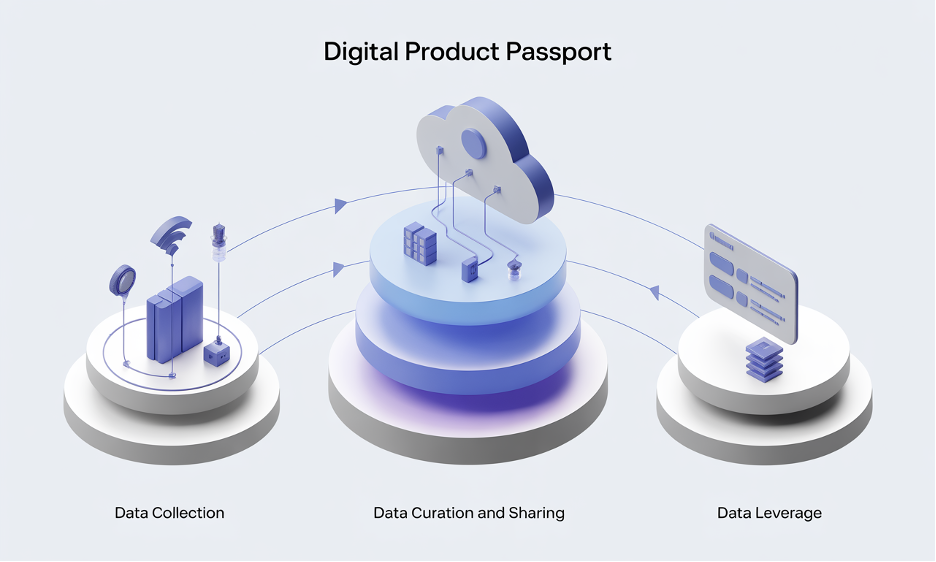
A DPP system is typically structured into three essential layers:
- Layer 1: Data Collection: Records information on product attributes using manual data entry or technologies like sensors and Internet-of-Things (IoT).
- Layer 2: Data Curation and Sharing: Processes and ensures the accessibility of the collected data. This layer leverages technologies such as cloud computing, Big Data Analytics, Machine Learning for security and accessibility.
- Layer 3: Data Leverage: Represents the interaction with the final user (consumer or organization), potentially enabled by blockchain technologies for secure, decentralized, and transparent data utilization.
Legislative Aspects
For the DPP to work well, policymakers should define mandatory data requirements and provide strong regulatory support and incentivization. The EU is driving this by integrating DPPs into its framework to enforce transparency, traceability, and sustainability. The Ecodesign for Sustainable Products Regulation (ESPR) is a cornerstone, mandating that products sold in the EU provide verifiable digital information about their lifecycle, and the DPP must be uniquely linked to the product and accessible.
Another key regulatory aspect is standardisation. An example of it is EU Batteries Regulation, which mandates the creation of a battery DPP for all large batteries to track and disclose comprehensive information on composition, recycled content, and other attributes. Such regulations mandate the collection and sharing of critical product data, providing a clear pathway for the transition to sustainable business models.
Technology
Implementing a DPP requires specific technologies across three layers. The Data Collection layer might use physical devices like sensors, IoT, and NFC/RFID tags with a Unique Product Identifier (UPI) to digitize product information. The Data Curation and Sharing layer processes this data using Cloud Computing, Big Data Analytics, and Machine Learning (ML), securing it with robust methods like Distributed Ledger Technology (DLT). Finally, the Data Leverage layer might use Blockchain and smart contracts to enable secure, automated, and transparent interaction with end-users.
Finance
Establishing a DPP demands significant upfront investment in technology and training to integrate it into current business operations. This cost can be a major hurdle, especially for Small and Medium-sized Enterprises (SMEs). While private financing covers most of the investment, public financing or incentives are often needed to help SMEs overcome the initial barrier. Operational costs include managing the large volumes of data and dealing with the potentially high costs and scalability issues associated with sophisticated technologies like blockchain.
Stakeholders
A DPP’s success depends on the active collaboration of all value chain actors and regulatory bodies. This includes manufacturers and suppliers providing product and material data, service providers using DPP data for maintenance, third-party recycling companies requiring composition and disassembly instructions, and customers using the data on environmental impacts for sustainable choices. Regulatory bodies must also be involved to set the rules. This multi-actor perspective ensures that the DPP captures the full scope of life cycle data needed by everyone.
Society
The primary social benefit is empowering consumers by increasing transparency about a product’s environmental impact, which fosters more sustainable purchasing decisions. This consumer awareness, in turn, drives manufacturer demand for circular products. The circular value chains are enabled by the individual actors having more information on the products. Therefore, thanks to DPPs, the value of products can be utilised more through circular strategies, such as repurposing or remanufacturing.
Environment
The DPP has a significant positive environmental impact as it is an enabler for the circular economy. By providing detailed information on material composition and recyclability, it boosts resource efficiency and improves recycling rates. It also facilitates circular design by allowing designers to optimize products for durability and repair. Furthermore, it allows for the monitoring and reporting of environmental metrics like GHG emissions, helping to optimize environmental performance across the entire value chain.
Governance
Effective governance models are crucial for enforcing compliance and managing the system. Governance must support the use of standardized data and implement layered data access to protect intellectual property while maintaining transparency for authorized parties. Such approach enables the DPP to act as a robust tool for supply chain compliance and provides regulators with dynamic insights needed to design effective future policies and manage product liability challenges.
Safety
The main risks associated with DPP operation are centered on data security and integrity. These risks include unauthorized data access, data tampering, and the potential for counterfeit products, especially when using simple carriers like QR codes. These safety concerns are primarily mitigated by the technological architecture, which uses secure protocols (DTLS), layered access control, and blockchain’s immutability to ensure the data’s authenticity and security.
Organisation
Organizational implementation should follow a strategic, phased approach: the rollout should start small with less complex product groups and incorporate iterative refinements based on feedback. A sufficient time should be allocated to identifying data needs, as it is a multi-stakeholder, collaborative process that requires time for consensus. The successful implementation is viewed not as a single project, but as an ongoing process that requires continuous stakeholder dialogue and governance by competent institutions.
Steps for a Successful DPP Implementation
1. Define Data Needs
– Identify Data Requirements: Facilitate collaboration involving all relevant stakeholders (suppliers, manufacturers, service providers, customers, recyclers) to define the specific data needed for their respective decision-making contexts (e.g., sustainable procurement, maintenance, end-of-life treatment).
– Prioritize Key Data Categories: Ensure the collection of critical data, including: product identity (serial/product numbers), material composition, hazardous substances, disassembly instructions and maintenance manuals, and adherence to regulations (e.g., RoHS, REACH).
– Select Appropriate Data Carrier Technology: Attach a unique product identifier (UPI) to the product. Use QR codes for low-cost, basic information, or opt for NFC/RFID electronic tags for enhanced data encryption and automated, contactless data access.
2. Establish Secure Data Curation and Sharing
– Create a Back-End System: Utilize cloud or edge computing technology to create a networked digital storage accessible to all value chain actors for data sharing.
– Ensure Data Security: Implement secure protocols for data transfer or use Distributed Ledger Technology to provide immutability and verifiability for shared data.
3. Facilitate Efficient Data Governance
– Ensure Data Verifiability and Standardization: Verify all included information against internationally recognized standards to ensure trust, facilitate direct product comparisons, and support sustainable practices.
– Enforce Layered Data Access: Implement multiple levels of access control to protect sensitive information and intellectual property rights, ensuring only relevant stakeholders can access specific data.
For more details on the technicalities of the implementation, please see Chapter 2.3 in the Report on digitalization, logistics and spatial optimization.