
Case Norway and Finland | System Dynamics Sustainability Assessment of Circular Batteries Case
Author: Tomáš Slaný (GreenDelta)
The goal of this case study was to understand how sustainable and how circular it is to give electric-vehicle (EV) batteries a second life. When an EV battery has aged too much to power a car, it often still holds enough capacity to be useful for storing electricity in a fixed location, for example to balance the grid or to shave the peaks off a building’s power demand. The study looked at whether building stationary energy storage systems (often called BESS) from these repurposed batteries is a good idea environmentally, economically and socially, and what policies might help.
Read our best practices for replication:
The focus is on lithium-ion batteries in two roles: powering vehicles (EV batteries) and storing energy in fixed installations (stationary batteries). Four battery chemistries were studied: NMC (nickel-manganese-cobalt), NCA (nickel-cobalt-aluminium), LFP (lithium-iron-phosphate) and LMO (lithium-manganese-oxide). NMC is the most common EV chemistry today, while cheaper LFP is expected to take over much of the market in the coming decades. The chosen region was Stor-Oslo in Norway, an ideal testing ground because Norway has the highest share of electric cars in the world and therefore the relatively largest coming wave of retired batteries.
The study followed the whole life cycle of batteries: production, import into the region, sale and distribution, use, collection once it reaches end of life, and then one of two fates. A battery can be repurposed (tested, reassembled and given a second life as stationary storage) or recycled (so that valuable metals like cobalt, nickel and lithium can be recovered and sold back into the market, replacing freshly mined material). The handover point between these two paths matters a great deal and is governed by a so-called cell-conversion rate, the fraction of retired EV cells still healthy enough to be reused.
To assess all of this, a novel sustainability assessment approach was applied: a combination of life cycle assessment (LCA) and system dynamics. LCA measures the environmental footprint of a single product across its whole life, here one kilowatt-hour of electricity delivered by a storage system. System dynamics models the whole regional market over time, capturing how supply, demand, prices and battery flows feed back on one another over decades. To this, the battery study added two further dimensions: a life cycle cost analysis (the money spent and saved across the battery’s life) and a screening social risk assessment (e.g. the risk of poor working and living conditions along the supply chain). The simulation ran from 2024 to 2064, because some battery policies take decades to show their full effect.
The environmental models were built in the software openLCA using the ecoinvent database, adjusted with a tool called premise used to project how background conditions (such as a cleaner electricity grid) change in future years. The system dynamics model was built in a system-dynamics software Stella. It contains 204 interlinked variables tracking resources, material flows, market prices, several end-of-life pathways, production planning, and environmental and economic outcomes. The environmental footprint was measured across nine standard categories, including climate change, energy and metal resource use, toxicity to humans and freshwater, land use and water use.
LCA Results
The LCA compared a brand-new (“first-life”) stationary battery against a second-life one at three real demonstration sites: Lempäälä in Finland, and Rudskogen and Trosvik in Norway. Two allocation rules were tested for sharing the environmental burden of EV batteries between the first and second lives. Under the 50/50 rule, the second-life system inherits half of the original manufacturing burden. Under the cut-off rule, the retired battery is treated as a waste product that arrives burden-free, carrying none of its original manufacturing footprint, only the cost of testing, reassembling, and new components that are added to the repurposed battery.
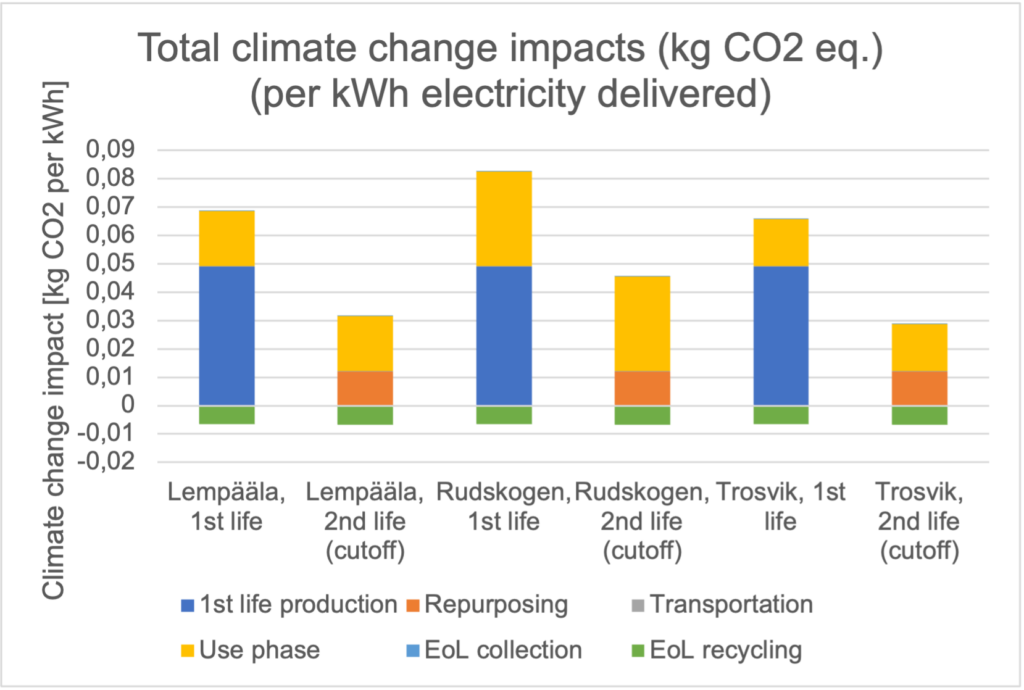
The results show that the 2nd life system consistently outperforms the 1st life one regardless of the site, and across all impact categories examined. Moreover, the choice of the allocation approach was found to have a significant effect on the impacts of the 2nd life batteries. Under the cautious 50/50 rule, second-life batteries cut the climate impact only modestly, by roughly 13 to 14 percent. Under the cut-off rule, the reduction jumped to around 60 percent or more, with even larger cuts (over 90 percent) for other impact categories. Analysis of life cycle stage contributions showed that the use-phase electricity explains most of the differences between sites. Because charging electricity is “consumed” by the battery, a dirtier local grid means a larger footprint regardless of which battery is installed. The lesson is that environmental comparisons between regions are meaningless unless they account for the local electricity mix.
Life cycle costing results
The cost analysis revealed that the financial case for these batteries depends less on the battery itself than on the local electricity billing rules. The biggest money flow over a battery’s life was not a cost but a saving: the revenue earned from peak shaving, that is, storing energy and using it to avoid more expensive high-demand charges. Norway’s billing system rewards this far more than Finland’s. As a result, both Norwegian sites turned an overall profit over the battery’s life, while the Finnish site ran at a net cost for every configuration tested.
Second-life batteries are roughly 30 percent cheaper to put in place than new ones, so at sites with modest savings they were the most economical choice, with second-life NMC the clear winner. But at Rudskogen, where peak-shaving savings were unusually large, a brand-new battery actually paid off better, because its longer lifetime earned enough extra revenue to outweigh its higher purchase price. Therefore, it can be concluded that second-life batteries make the most economic sense in settings with more constrained savings potential.
Social risk screening results
The social risk assessment used country- and sector-level data integrated into soca database to flag where the risk of poor conditions is highest, rather than to prove harm at any specific site. For new batteries, the top risks clustered around mining and cell-manufacturing regions: poor sanitation for surrounding communities and high rates of workplace accidents. For second-life batteries, the risk profile was broader and in places more severe, with governance and civil-liberties concerns (such as press freedom and human trafficking) rising to the top. Neither system was clearly “better”, as both shared inadequate basic infrastructure in the upstream supply chain as a persistent concern. These risks should be further examined by collecting real-world data.
Regional assessment results
The system dynamics model simulated the Stor-Oslo region under four scenarios: business as usual, a tenfold increase in repurposing capacity, a rule mandating that half of all retired EV batteries be reused, and a combination of the last two.
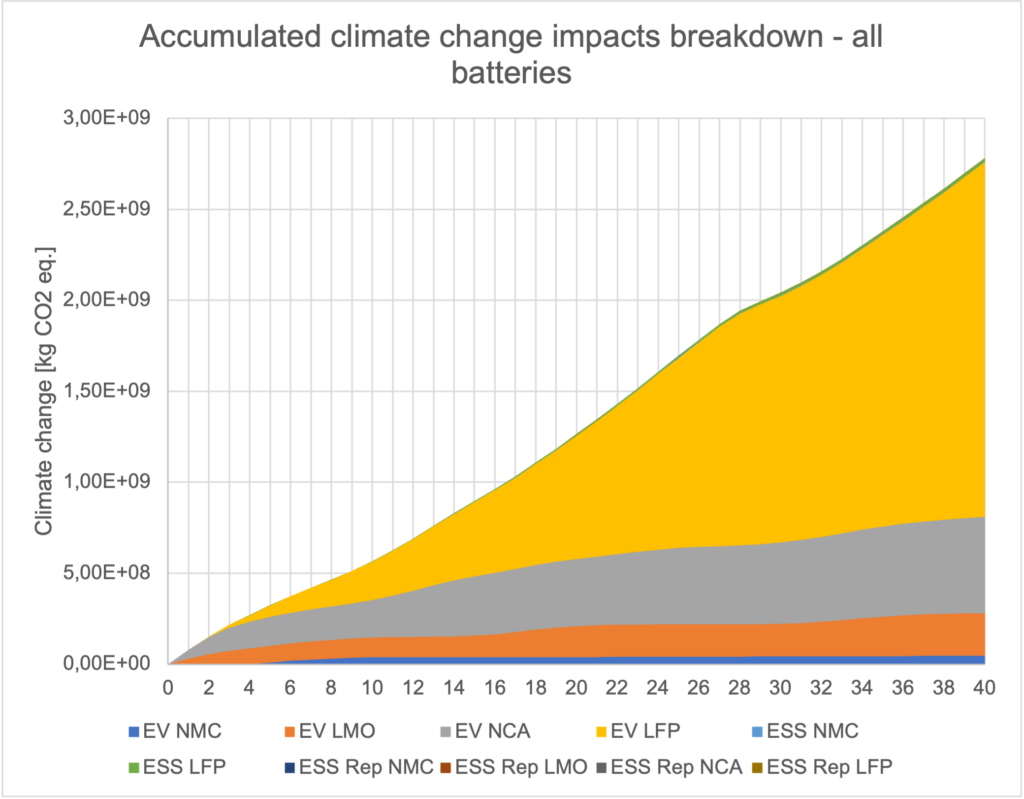
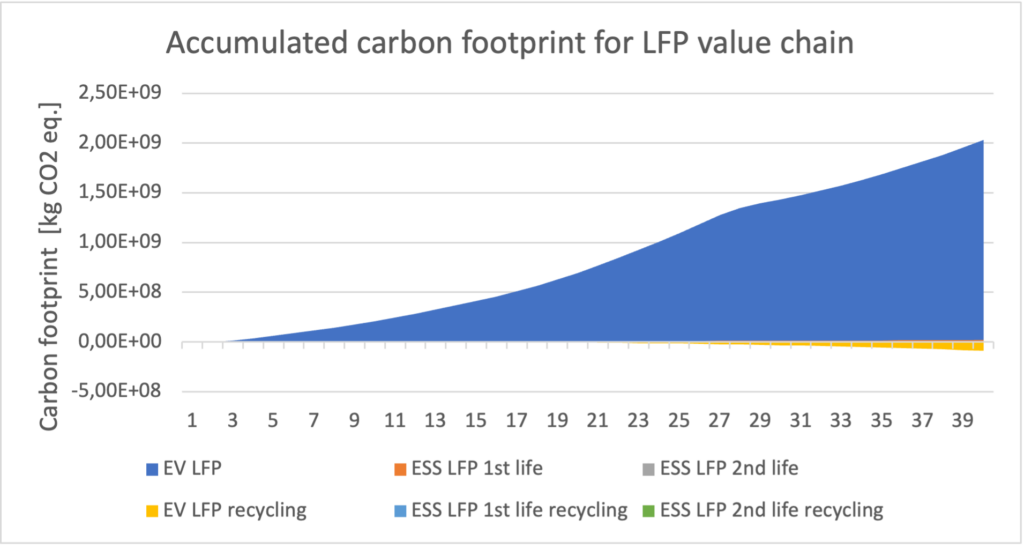
The region’s total battery footprint was found to be overwhelmingly driven by EV battery production, not by stationary storage. Even at the peak of second-life deployment, repurposed batteries are only a tiny fraction of the total volume of retiring EV batteries. As a consequence, none of the tested policies made much difference to the regional total. Even increasing repurposing capacity tenfold barely moved the needle, because the bottleneck is not a lack of processing capacity but the simple fact that stationary storage demand is small next to the sheer scale of the car fleet.
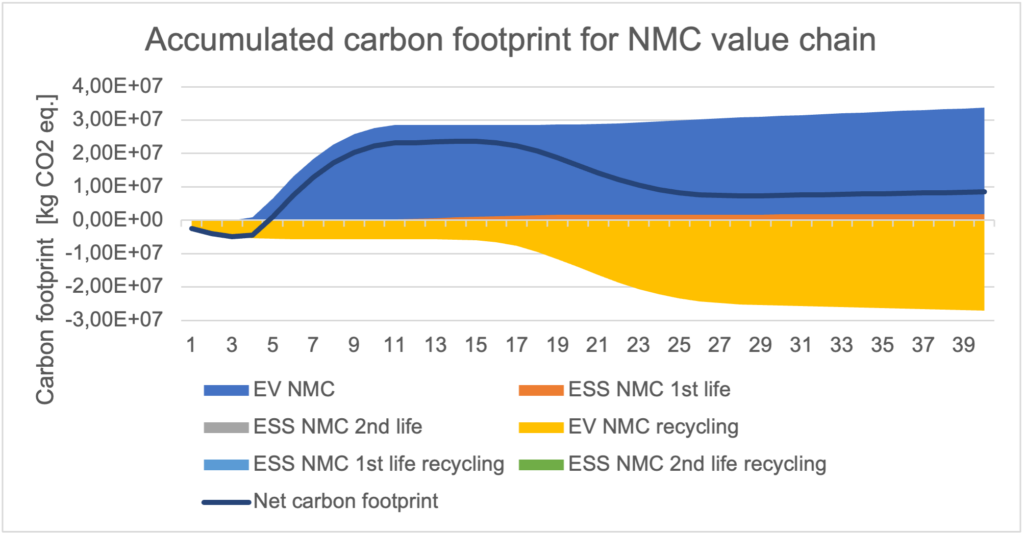
A second key insight concerned recycling, and here the two chemistries diverged sharply. Recycling NMC batteries recovers valuable cobalt, nickel and manganese, generating a “credit” large enough to cancel out roughly two-thirds of the chemistry’s total carbon burden. Recycling LFP, by contrast, mostly yields low-value iron and phosphate, producing much smaller environmental benefit. This matters because LFP is set to dominate the future fleet: as it does, the credits from recycling available today will shrink unless recovery technology improves.
What it all means
This analysis generated a few practical recommendations. First, where peak-shaving value is moderate, prioritising second-life batteries makes sense, as they are cheap, low-impact and recover valuable metals at end of life (in case of NMC). Second, recognise that energy billing rules, more than battery technology, decide whether storage pays for itself, so billing frameworks that reward peak shaving would unlock far more investment. Third, when aiming to use the battery storage system with the lowest environmental impacts, 2nd life systems are the best choice. Fourth, on a regional level, a priority of climate policy should be decarbonising EV battery manufacturing, the charging grid and optimising the recycling processes rather than expanding repurposing infrastructure, since that is where the footprint actually sits.