

Case Tallinn | KopliFest Shows How a Community Day Can Go Circular
Authors: Teele Joost from City of Tallinn and Marjoriikka Ylisiurua & Minna Kulju from VTT
Kopli is a waterfront district in Tallinn, Estonia, with a strong industrial heritage that is rapidly evolving into a creative and community‑driven area. At KopliFest, circular economy practices were integrated into the yearly local community event. The aim was to reduce material footprints and help visitors experience practical examples of circularity in everyday life.
Choosing Locations to Support Sustainable Travel
The event locations in 2023 and 2024 were selected to encourage low‑impact travel. In 2023, KopliFest took place in Kase Park, a centrally accessible green space with good public transport and cycling connections. In 2024, the festival moved to Kopli Kalasadam, a seaside venue with improved bicycle access and several designated bike‑parking points.
Both areas intentionally placed large car parks away from the festival grounds. This approach guided visitors toward walking, cycling and public transport without compromising accessibility.
Power and Water – Practical Adjustments with Visible Effects
Electricity for stages, lighting and sound was drawn from the stationary grid, which includes a share of renewable energy. Food vendors relied on biodiesel generators positioned near the vendor area. While generator emissions remain an area for improvement, the overall direction shows a gradual shift toward cleaner energy solutions.
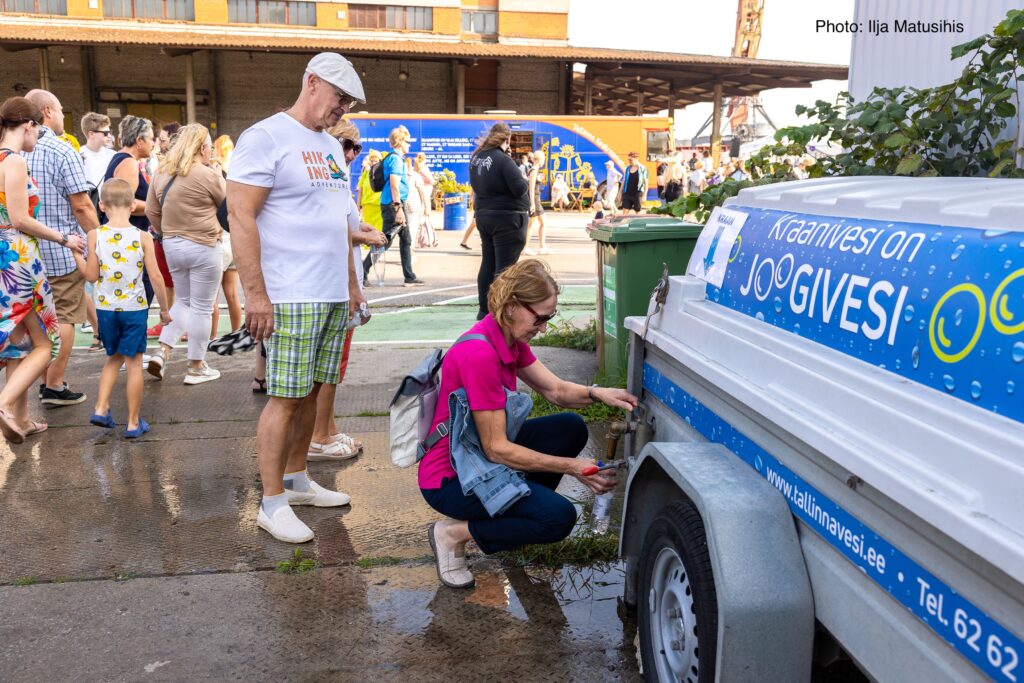
In 2024, the event introduced a free water‑refill point. A 500‑litre tank on a trailer provided drinking water throughout the day and was emptied during the event, likely displacing around 700 single‑use water bottles. This small addition reduced plastic waste and supported visitors in choosing reusable containers.
Less Single‑Use and Cleaner Waste Fractions
To improve sorting, the number of waste stations was increased to match the larger event area in 2024. A dedicated stream for deposit bottles and cans was added, and the festival avoided distributing flyers, merchandise and other promotional items.
Single‑use items were mostly associated with food vendors. In cases where reusables were not feasible, such as cones or napkins, clear signage and well‑placed bins helped reduce contamination and keep waste fractions cleaner.
Deposit Systems for food Containers
Since June 2023, Tallinn requires reusable foodware at events. KopliFest vendors adopted this through a deposit system for bowls, plates and cups. Visitors found the system easy to use, and clear return points helped ensure smooth circulation of reusable items across the day. This contributed to further reducing single‑use materials in a high‑volume part of the event.
Engagement Through Hands‑on Activities
KopliFest activities played an important role in making circularity visible and approachable. Visitors could upcycle jewellery, paint on old ceramic plates that had lost their visual appeal and were no longer valued by most people or explore second-hand clothing.
The city’s library bus added to the atmosphere, supporting families to see reuse as part of their current life already. Feedback from visitors highlighted the popularity of the hands-on activities that combined creativity with practical sustainability.

What We Learned for Replication
The experience from two editions of circular KopliFest points to several transferable insights:
- Design choices influence behaviour: Location and mobility options shape how visitors move to and within the event.
- Convenience supports adoption: Refill points and deposit systems help make reuse the default option.
- Engagement strengthens understanding: Hands-on activities build familiarity with circular practices.
- Continuous improvement helps: Each event provides opportunities to refine energy use, water access and sorting arrangements.
How to Make Your Event Circular
Observe Your Event Performance
Begin by identifying how your event currently performs in key event sustainability areas such as waste generation, sorting accuracy and CO₂ impacts. Understanding this baseline helps pinpoint where circular actions can have the greatest effect.
Orient and Define Your Sustainability Focus
Based on the baseline, identify the areas where the event creates its largest impacts and where action is most needed. For example, the problem area might range from transport‑related emissions to food waste or the use of single‑use materials. Choose one or two priority circular economy areas and set clear goals and indicators. A narrow focus helps organisers make meaningful progress and monitor results.
Decide Relevant Circular Economy Actions
Select the actions that best support your goals. These may include reducing plastic waste, switching to reusable systems, improving sorting stations, or engaging visitors and vendors in low‑impact choices. Decisions are typically informed by policy requirements, city guidelines, certifications and practical feasibility.
Act and Learn from Implementation
Circularity is implemented before, during and after the event. Monitor how well each measure performs and collect observations or data where possible. Continuous evaluation helps refine activities for future events and supports long‑term circularity.